
🚚 Free Shipping (3-5 Business Days) | 🛡️ 30-Day Money-Back Guarantee | 🏆 6-Month Warranty | ⭐ Trusted by 1000+ Happy Customers

The Recovery Paradox: Why Pushing Harder Often Destroys Your Healing
You feel better, so you test it. You push a little and it holds. So you push more. And then without warning, you’re back at square one worse than before.
The actions that feel most productive silencing pain signals comparing your progress to someone else’s highlight reel rushing back to the sport that defines you. These are precisely what cause re-injury. Social media feeds you “rapid recovery” protocols and bio hacking shortcuts that ignore the one variable that actually matters tissue tolerance.
Key Takeaways
Recovery is governed by tissue healing phases (inflammatory, proliferative, remodeling) not willpower loading that feels fine at week 1 can destroy fragile collagen cross-links at week 3
The two-hour pain rule is your most reliable recovery compass: if pain or swelling increases two hours after activity, you exceeded tissue tolerance regardless of how you felt during the activity
Complete rest is as dangerous as aggressive loading: sub-threshold movement snacks and contralateral training preserve strength and neuromuscular control without overloading healing tissue
Sleep (7-9 hours) and protein distribution (20-40g every 3-4 hours) are non-negotiable physiological requirements not wellness suggestions: growth hormone pulses and muscle protein synthesis depend on them
Psychological drivers (anxiety about fitness loss, athletic identity, kinesiophobia) cause more loading errors than physical ignorance address the mental trigger not just the movement mistake
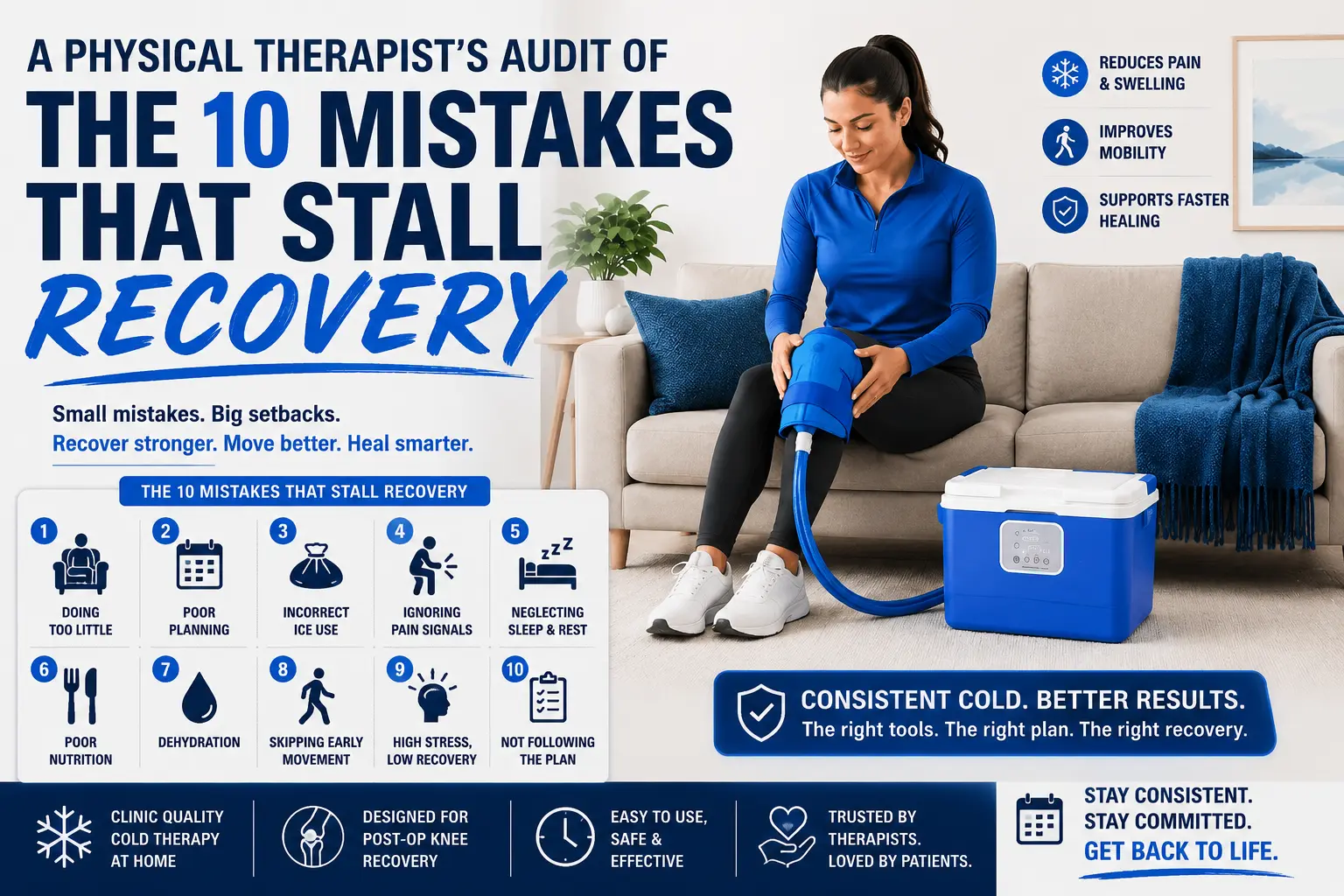
This article is a physical therapist’s audit of the ten most common mistakes that stall recovery each paired with a phase-specific replacement protocol grounded in tissue healing science. No cheerleading. No miracle timelines. Just the clinical rules that determine whether you heal or re-injure.
I’ve spent years in post-surgical and sports-injury clinics where cold therapy after knee surgery is common, watching disciplined, motivated people sabotage their own healing because no one taught them the difference between productive discomfort and harmful load. The advice here is skeptical of influencer culture because I’ve seen the consequences of that advice in my clinic.
Protocols vary by injury type, age and comorbidities, which means cold therapy for arthritis pain requires different guidance. This content does not replace personalized medical advice, nor does it endorse any specific power adapter for cold therapy machine. Consult your healthcare provider and review essential cryotherapy contraindications before altering your rehabilitation plan.
Now let’s examine why the very mindset that makes you a disciplined athlete or active person, the urge to push, test and compare becomes your biggest liability the moment tissue tears.
The Recovery Paradox: Why the Actions That Feel Productive Often Destroy Progress
The introduction laid out the uncomfortable truth: the actions that feel most productive during recovery are often the ones that set you back. Now let’s examine why that is and how the cultural noise around “hustle” and “biohacking” actively works against your tissue’s healing timeline. Recovery is not a motivational deficit or a heat versus cold therapy dilemma. It’s a biological sequence with rules that don’t care about your grit.
How ‘Hustle Culture’ Hijacks Rehabilitation
Fitness influencers sell a “no days off” identity that maps poorly onto physiological healing. Tissue does not respond to willpower. It responds to graded exposure load applied within its current tissue tolerance.
During the proliferative phase collagen is being deposited rapidly but the fibers are disorganized. The tissue feels better, yet it lacks functional integrity. Pushing harder at this stage disrupts fragile collagen cross-links before they can orient to load setting the stage for re-injury.
Biohacking trends that frame rest as weakness ignore the fact that the inflammatory phase requires a deliberate pause for cellular cleanup.
The real discipline is not grinding through pain it’s respecting a timeline you cannot see.
Complete rest is equally destructive. Depriving a healing tendon of mechanical loading reduces cell density, alignment and extracellular matrix organization. The solution is not all-or-nothing. It’s movement snacks frequent, sub-threshold movements that prevent deconditioning without exceeding the tissue’s current capacity.
Hustle culture frames this as “doing nothing,” but it’s the most precise work you’ll do.
Why Feeling Busy Often Means You’re Overloading Tissue
Aggressive stretching, testing your range of motion and pushing into discomfort feel like progress. The sensation of effort is seductive. But in early healing that sensation is a poor proxy for productive adaptation.
Premature loading during the proliferative phase risks disrupting collagen cross-links before they can organize into load-bearing structures. You feel busy, you feel like you’re “fighting” for your recovery. But you’re actually dismantling the scaffold your body is trying to build.
Effort is not adaptation. The tissue that feels tight isn’t asking to be forced; it’s signaling that its mechanical integrity is still fragile. I’ve watched patients stretch aggressively at week 2 because they felt guilty resting. That guilt is a cultural artifact not a physiological signal.
When Rest Felt Like Falling Behind
There was a phase in recovery where everything in my plan said “hold back” but mentally, that felt unacceptable. The pain wasn’t sharp. It was subtle. Manageable. Easy to justify pushing through.
So I did.
Added extra volume. Ignored the stiffness. Kept telling myself:
“If it’s not severe, it’s fine.”
But underneath that decision wasn’t logic it was pressure.
- Pressure to stay consistent.
- Pressure to not “lose progress.”
- Pressure to match what I thought others were doing.
The Social Media Detox Prescription
Social media comparison accelerates anxiety-driven loading errors by normalizing unrealistic timelines. A curated feed audit is a clinical intervention not a wellness trend. Start by identifying accounts that make you feel behind. If a post showcases a rapid return-to-sport without disclosing injury grade, setbacks or the actual phase of healing, it’s distorting your internal clock.
Expert Tip: Control Your Inputs, Protect Your Recovery
Unfollow accounts that showcase rapid return-to-sport timelines without context.
If a post doesn’t clearly disclose:
- Injury grade
- Rehab phase
- Setbacks or delays
…it’s not a complete story.
Replace them with clinicians who explain phase-specific constraints. The goal is not to eliminate motivation but to recalibrate your expectations to match tissue physiology. When your feed stops screaming “you’re falling behind,” the compulsion to test limits prematurely loses its fuel.
Understanding the mindset problem is step one. Step two is mapping your specific behaviors to where you actually are in the healing timeline. Because a mistake at day 3 and a mistake at week 5 are completely different animals.
Phase-by-Phase: Mapping Mistakes to Your Healing Stage
Understanding the mindset problem is step one. Step two is mapping your specific behaviors to where you actually are in the healing timeline because a mistake at day 3 and a mistake at week 5 are completely different animals.
Tissue healing phases dictate distinct loading tolerances. A safe action at week 6 can be destructive at week 1. The three phases, inflammatory, proliferative and remodeling each carry their own mechanical rules. The errors that derail recovery change with them.
Inflammatory Phase (Days 1-7): When Total Rest Becomes Risky
The inflammatory phase is not a design flaw. It’s the necessary first responder. Swelling delivers cellular cleanup crews and signaling molecules that lay the foundation for every repair step that follows.
Protection is mandatory. Complete immobilization, however, is a separate, self-inflicted injury, so patients may prefer a replacement knee wrap and controlled movement instead. Research shows that depriving healing tendon of any mechanical load reduces cell density, alignment and extracellular matrix organization, the very structural quality you’re trying to preserve.
The tension is real. You must shield the tissue and you must feed it mechanotransduction signals even in the earliest days, when a replacement hose tube may be needed for cold therapy protocols.
Mistake: Complete Immobilization / Fix: The Micro-Dose Movement Protocol
The instinct to lock everything down is understandable. It’s also counterproductive.
The fix is not “light activity.” That phrase is too vague and easily overshot. The fix is movement snacks, frequent, sub-threshold, pain-free movements dosed in tiny predictable amounts. Think ankle pumps, gentle isometric quad sets or unloaded wrist circles performed for 30-60 seconds every waking hour.
These micro-doses send the mechanical signals that tell fibroblasts where to align and how densely to pack, without exceeding the tissue’s current capacity. The goal is not exercise or a cold therapy machine buying guide. It’s biological communication.
Expert Tip: Don’t Stop Moving Scale It
Complete rest is rarely the optimal strategy for recovery. Instead, use movement snacks frequent, low-intensity, pain-free movements that stay below your tissue’s tolerance threshold.
Managing (Not Eliminating) Inflammation
For the first 48-72 hours, your job is to manage the inflammatory cascade not shut it down. Aggressive icing and around-the-clock anti-inflammatories can blunt the very cellular signaling that drives debris clearance and repair initiation.
Elevation, gentle movement and compression are your primary tools. Ice has a role for pain relief but it’s a short-duration adjunct not a treatment strategy. Track symptoms objectively during this volatile window. This helps you distinguish normal inflammatory behavior from warning signs.
Expert Tip: Respect the Inflammation Window
Early inflammation is not a problem, it’s a critical phase of healing.
In the first 48-72 hours, swelling supports:
- Cellular cleanup
- Tissue repair signaling
- Natural recovery progression
What Most People Get Wrong
The biggest mistake is trying to eliminate inflammation too early.
This includes:
- Aggressive icing
- Overuse of anti-inflammatories
- Completely shutting down movement
These approaches can interfere with the body’s repair process.
The Smarter Approach
Instead of suppressing inflammation control it intelligently:
- Use elevation to manage excess swelling
- Introduce gentle, pain-free movement
- Avoid extreme or uncontrolled cold exposure
Where FeelGoodEase Makes the Difference
This is where most traditional methods fail and where your setup matters. The FeelGoodEase Cold Therapy Machine allows you to:
- Maintain a controlled therapeutic temperature (not too cold)
- Avoid overcooling during the sensitive early phase
- Apply targeted cold + compression instead of full suppression
- Support swelling reduction without disrupting healing signals
Proliferative Phase (Days 7-21): The False Security of ‘Feeling Better’
This is the highest-risk window in recovery. Pain fades. Swelling recedes. The tissue feels better and the brain interprets that as a green light.
But under the surface, the proliferative phase is laying down collagen at a furious pace. That collagen is disorganized, poorly cross-linked and mechanically fragile. The tissue has volume not integrity. Loading based on symptom resolution is the single most common re-injury driver I see in clinic.
Mistake: Loading Because Pain Subsided / Fix: The Collagen Maturation Timeline
Pain is a lagging indicator of tissue readiness. In the proliferative phase, collagen is present but the cross-links between fibrils are sparse and disorganized. Premature loading disrupts those fragile connections before they can align into load-bearing structures.
The tissue’s mechanical response to load actually diminishes over repeated early stress. You’re not building capacity. You’re degrading it.
The fix is to respect the collagen maturation timeline not the pain scale. Loading decisions must be guided by phase-specific criteria. Use isometric work that stays well below symptom threshold. Avoid stretch-shortening cycles and ballistic movement. The runner who jogs at day 10 because the ankle “feels fine” is running on a scaffold of wet spaghetti.
Why Visible Improvement Hides Functional Deficits
Even when swelling and pain resolve significant functional gaps remain:
- Proprioception deficits. The joint’s position sense is dulled increasing re-injury risk during quick direction changes.
- Tensile strength well below pre-injury levels. The tissue can handle daily loads but not sport-specific forces.
- Motor control degradation. The neuromuscular system has adapted to guarding patterns that persist after pain fades.
- Neuromuscular inhibition. Protective reflexes suppress full muscle activation leaving the joint dynamically unstable.
Remodeling Phase (Week 3-6+): The Quiet Errors That Cause Recurrence
The remodeling phase is the longest and most neglected stage. Collagen finally realigns along lines of stress and tensile strength slowly approaches pre-injury levels.
Errors here are less dramatic. There are no sudden re-tears. Instead, they produce the chronic recurrence patterns that plague athletes for years. This is where you address the why, not just the what.
Expert Tip: Fix the Cause, Not Just the Injury
The remodeling phase is where most people lose the opportunity to fully recover. Pain is reduced. Movement feels better. So the focus shifts back to normal activity. But this is exactly when the real work should begin.
Mistake: Ignoring the Biomechanical Root Cause / Fix: The Movement Audit
The injury didn’t happen in a vacuum. A tissue failed because the load exceeded its capacity and that overload usually has a predictable biomechanical story: a hip that doesn’t stabilize, a foot that doesn’t absorb shock, a trunk that doesn’t transfer force.
The remodeling phase gives you months to run a movement audit. Film yourself performing the movement that caused the injury: squat, lunge, run, throw and look for the collapse point. Then build a corrective program that targets the weak link.
Rehab that only treats the injured structure without fixing the system that broke it is a recipe for the same injury, different season.
Those phase-specific errors are the timeline mistakes. Now let’s look at the physical errors that cut across phases: the movement, load and pain-management decisions that go wrong regardless of what week you’re in.
The Physical Errors: Movement, Load and Pain
Those phase-specific errors are the timeline mistakes. Now let’s look at the physical errors that cut across phases, the movement, load and pain-management decisions that go wrong regardless of what week you’re in. These five mistakes recur in clinic week after week and each one has a psychological trigger that drives it.
Anxiety, athletic identity, fear of losing fitness, the mental state directly produces the loading error. Fix the physical pattern without addressing the driver and the mistake returns.
Why You Keep Re-Injuring: The Mind-Body Link Most People Ignore
Most recovery advice focuses only on physical mistakes. But in reality, those mistakes are often driven by psychological triggers. Until you address both, the cycle repeats.
The Hidden Pattern
Every load error has a mental driver behind it.
| Physical Mistake | Psychological Driver |
|---|---|
| Returning to training too early | Anxiety about losing progress |
| Overtraining during recovery | Identity tied to athletic performance |
| Ignoring pain signals | Fear of falling behind |
| Skipping rest days | Guilt associated with inactivity |
| Pushing intensity too fast | Social comparison pressure |
Returning to Activity Too Aggressively
The re-injury cycle is predictable. Tissue feels better, the athlete tests it, the test goes well and within days they’re back at full intensity. The problem is that feeling better during the proliferative phase does not mean the tissue can handle sport-specific load.
Collagen is present but disorganized the fragile cross-links that will eventually give the tendon or ligament its tensile strength haven’t formed yet. Loading too aggressively at this stage disrupts that scaffolding before it can organize and the tissue fails again, often worse than the original injury.
A patient recovering from a moderate ankle sprain reaches week 4 and starts to feel significantly better.
Pain is minimal. Movement is easier. Confidence is back. So they make the decision to return to sport.
The psychological trigger here is rarely simple impatience. It’s identity. For someone whose self-worth is tied to performance being sidelined feels like disappearing. Anxiety about detraining and fear that every missed session erases years of work create a pressure that overrides the body’s actual readiness.
The corrective protocol is not just a slower timeline; it’s a graded exposure plan that gives the athlete objective, incremental benchmarks so they can see progress without guessing. Return-to-sport testing must include sport-specific loading drills performed at sub-maximal intensity with clear pass/fail criteria based on swelling, pain quality and movement control, not on how “good” it felt in the moment.
Confusing Complete Rest With Strategic Movement
Rest is not a binary. Total immobilization deprives healing tissue of the mechanical signals it needs to organize. Without any load, cell density drops, collagen alignment suffers and the extracellular matrix becomes disorganized, a repair that looks fine on ultrasound but fails under real-world demand. Yet the instinct to “just rest it completely” is strong especially when movement hurts.
The psychological driver is often kinesiophobia, fear of movement itself or a well-meaning but outdated belief that any loading during healing is dangerous. The corrective protocol replaces the rest-versus-activity question with a dosage decision.
In the inflammatory phase, movement might be nothing more than gentle, pain-free range-of-motion exercises that prevent joint stiffness without stressing the injury. By the proliferative phase, sub-threshold loading (loads that stay well below the tissue’s current tolerance) becomes essential.
The key is to never exceed the tissue’s capacity while ensuring it receives regular, low-intensity mechanical input. This is where movement snacks (frequent, short-duration, low-load movements) prevent deconditioning and maintain neuromuscular patterns without crossing into aggravation.
Using Anti-Inflammatories to Mask Pain Signals
Pain is data, not an enemy. Nociceptive signals are the body’s built-in load gauge. When you silence them with NSAIDs to push through a workout or a workday, you remove the very feedback that prevents overload.
The tissue may be signaling that collagen cross-links are being strained beyond their current capacity masking that signal lets you exceed the safe mechanical window without knowing it. The result is micro-damage that accumulates silently setting up a delayed failure days or weeks later.
There is a legitimate role for anti-inflammatories, when excessive swelling itself impedes joint motion or when pain is so severe it prevents essential, protective movement. But using them to “get through” a training session or a long shift is a dangerous trade.
The psychological trigger is the desire to feel normal and productive to silence the reminder that you’re injured. The corrective protocol is to reserve NSAIDs for true functional impairment not for activity enablement and to use pain as a decision-making tool: sharp, localized pain that increases with load means stop diffuse, muscular soreness that eases with gentle movement is usually benign.
Abandoning Home Exercises When Symptoms Fade
The remodeling phase is the longest and least symptomatic part of recovery and it’s exactly when exercise adherence collapses. Once the swelling is gone and daily activities feel normal, the urgency evaporates. But this is the phase where disorganized collagen is being realigned along lines of stress and tensile strength is slowly approaching pre-injury levels. Stopping exercises now means the tissue never develops the load-bearing architecture it needs for sport or work demands.
Once pain reduces, adherence drops. In practice, approximately 60-70% of patients reduce or completely stop their home exercise program as soon as symptoms improve.
At that point, they feel “done.”
But recovery isn’t.
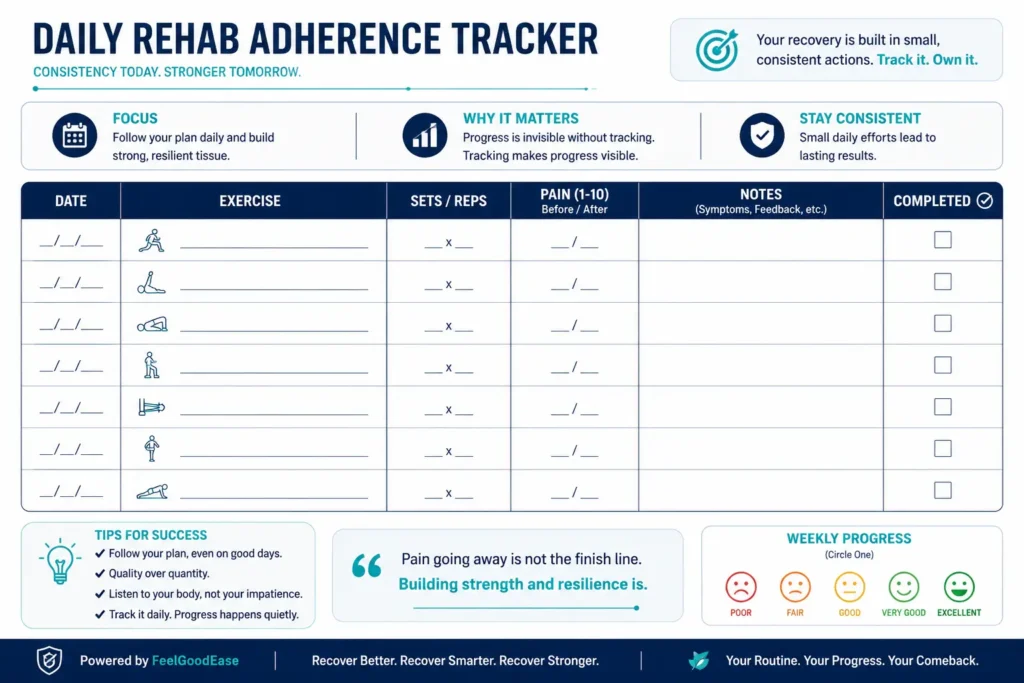
The psychological driver is a false sense of security. No pain feels like healed. The corrective protocol is to reframe the home program not as rehab but as tissue remodeling work, a deliberate, phase-appropriate loading plan that continues well past symptom resolution. Tracking adherence with a simple daily log makes the invisible work visible.
Contralateral Training: Loading the Uninjured Limb to Preserve the Injured Side
This is the most counterintuitive early-stage strategy. While the injured limb is protected, you train the uninjured side aggressively. The neurophysiological phenomenon of cross-education means that unilateral strength training produces moderate to large strength gains in the contralateral, untrained limb, preserving muscle mass, neural drive and motor control on the injured side without loading it at all. The mechanisms involve cortical adaptations and interhemispheric communication, not just systemic hormonal effects.
Expert Tip: Train the Uninjured Side to Protect the Injured One
One of the most overlooked recovery strategies is cross-education. When you train the uninjured limb, the nervous system adapts in a way that helps preserve strength and neuromuscular control on the injured side. This isn’t theory it’s a clinically supported mechanism.
What This Looks Like in Practice
Instead of pausing training completely, shift focus:
- Single-leg press (uninjured side)
- Single-leg Romanian deadlift
- Single-arm rows
Perform:
- 3x per week
- Moderate to high intensity
- Volume aligned with your pre-injury capacity
Product Recommendation: Build Smarter Protocols, Not Random Workouts
When designing contralateral or corrective programs rely on evidence-based protocols not guesswork.
Use references from:
- JOSPT (Journal of Orthopaedic & Sports Physical Therapy)
- Cochrane Library
These sources provide:
- Structured progression models
- Proven rehabilitation strategies
- Clinically validated outcomes
The Hidden Layer of Recovery
Most people focus on what they do physically. But some of the most damaging mistakes happen elsewhere:
- Emotional decision-making
- Poor sleep
- Inconsistent nutrition
- Mental stress and overthinking
When Your Support System Sabotages Recovery
You can nail every exercise, dial in your nutrition and protect your sleep, and still get sabotaged by the people around you. The final error category isn’t about what you do; it’s about what they do. Partners, parents, coaches and teammates often mean well, but their instincts pull in two destructive directions: over-coddling that prevents necessary loading or toxic positivity that demands loading the tissue can’t yet handle. Both mistakes ignore the physiological timeline that governs repair.
The Over-Coddling Trap: When Rest Becomes Enabling
A partner who insists you stay on the couch, a parent who brings every meal to your bedside, a friend who scolds you for walking too soon. This is care that crosses into harm.
The inflammatory phase (days 1-7) does require protection, but once the proliferative phase begins around day 7, the tissue needs controlled mechanical signals to organize the new collagen that’s being laid down. Without those signals, the repair stays disorganized and weak. Complete rest beyond the acute window doesn’t preserve healing; it delays it. Stiffness sets in, muscle atrophies and the nervous system loses its familiarity with normal movement patterns.
When “Rest More” Delays Recovery
A patient with a grade 2 ankle sprain was progressing through the early inflammatory phase appropriately rest, elevation and protection during the first few days.
But after that initial period something changed.
Their partner strongly encouraged complete bed rest believing that avoiding all movement would speed up healing.
Over-coddling is often rooted in anxiety, not evidence. The person watching you limp assumes that any movement is dangerous. They don’t know that tissue tolerance (the maximum load a healing structure can absorb without damage) is built through graded exposure not through stillness. When you explain that your ankle needs short, frequent, sub-threshold movements to remodel, you’re not being reckless. You’re following the biology.
Toxic Positivity and Pressure to ‘Tough It Out’
The opposite error is just as damaging. A coach who says “no days off,” a training partner who tells you to push through the ache, a social media feed full of rapid-return stories all of it pressures you to load tissue before it’s mechanically ready.
During the proliferative phase and early remodeling, collagen cross-links are fragile and disorganized. At week 3, for example, a tendon may feel better, but its fibrils still fail to respond properly to high loads premature loading can disrupt those cross-links before they organize into load-bearing structures. The encouragement sounds supportive but it’s asking your tissue to do a job it structurally cannot perform.
Toxic positivity ignores the remodeling timeline. It treats recovery as a test of will, not a physiological process with hard constraints. When you hear “you’ve got this” in response to pain, the subtext is that your body’s signals are weakness. That framing leads to loading errors that re-injure the tissue and reset the clock.
How Coaches and Partners Prematurely Encourage Loading
You need language that translates tissue science into boundaries a non-clinician can respect. The goal isn’t to lecture; it’s to give your support circle a simple, concrete reason to back off or step in appropriately. Here are scripts you can adapt:
- For the over-coddler: “My tissue is past the acute inflammation stage. It actually needs small, frequent movements now to organize the repair. Complete rest at this point makes it weaker, not stronger.”
- For the coach pushing early loading: “My tendon is only at week 3. The collagen is still disorganized and loading it too hard right now can tear the fragile cross-links. I’m following a graded exposure plan that adds load based on tissue tolerance not on how I feel.”
- For the teammate who equates rest with laziness: “I’m not skipping work. I’m doing contralateral training on my good side to keep strength signals going and I’m doing movement snacks throughout the day that stay below my tissue’s current capacity. That’s the protocol for this phase.”
Set Boundaries With Science: What to Say When Others Push You Too Fast
Recovery doesn’t happen in isolation. Coaches, family and even well-meaning friends often push for a faster return usually without understanding what’s happening inside the tissue.
This is where most setbacks begin.
These phrases work because they name a specific physiological reality (collagen cross-links, tissue tolerance, graded exposure) that most people haven’t heard. That specificity shifts the conversation from opinion to biology. You’re not arguing; you’re informing. And when your support system understands that your recovery follows a predictable timeline with distinct mechanical limits, they become allies instead of obstacles.
Myth vs. Fact: Evidence-Grade Reality Checks
Now that we’ve covered the mistakes your support system makes, let’s arm you with the ability to evaluate recovery advice yourself. Myths circulate faster than evidence and the next viral ‘hack’ is already being filmed.
You need a filter: the evidence hierarchy. Systematic reviews and meta-analyses sit at the top, followed by randomized controlled trials, then expert opinion. When an influencer claims a protocol “works,” ask what sits beneath it. A single anecdote is not evidence. A study of 12 college athletes is not a clinical mandate. This hierarchy is your bullshit detector and we’re about to use it on three myths that wreck recoveries.
Myth: Aggressive Ice Baths and Supplement Stacks Accelerate Healing
Biohackers treat recovery like an optimization problem, trying to use a cold therapy machine, taking more supplements and chasing more speed. Physiology disagrees.
The inflammatory phase (days 1-7) is not a mistake your body makes. It is the signaling cascade that clears debris and recruits the cells that will build new tissue. Aggressive ice baths blunt this response. They can suppress the very signals proliferation depends on. Systematic reviews on cryotherapy for acute soft-tissue injury consistently show pain relief not accelerated structural repair. The tissue still needs its full timeline.
Supplements hit the same wall. Collagen synthesis and cross-link formation are rate-limited by enzymatic processes not raw material availability. Flooding the system with vitamin C, gelatin and turmeric cannot override the remodeling phase’s slow, load-dependent collagen realignment. Evidence for most recovery supplements sits at expert opinion or small, industry-funded trials nowhere near the systematic-review level that would justify centering your protocol around them.
When Biohacking Replaces Clinical Thinking
A pattern that’s becoming more common is the use of “biohacking” protocols during recovery.
In one case, a patient followed a routine they had seen online:
- Daily ice baths
- Multiple supplement stacks
- Aggressive recovery rituals
On the surface, it looked disciplined. But it wasn’t aligned with the injury phase.
The physiologically grounded alternative is not passivity. Gentle, sub-threshold movement during the inflammatory phase or movement snacks, supports fluid clearance without disrupting the repair cascade. Save the ice for acute pain management not as a healing accelerator.
Myth: If Swelling Is Down, You’re Ready to Load
Swelling is a cosmetic milestone not mechanical clearance. The proliferative phase (days 7-21) deposits collagen rapidly, but the fiber orientation is disorganized. Tissue feels better and the ankle no longer looks like a grapefruit so the brain assumes readiness. That assumption is dangerous.
Hidden deficits remain in proprioception, tensile strength and motor control. At week 3, a healing tendon has collagen present but fragile cross-links; its fibril response to mechanical loading is impaired. Loading too early risks disrupting the scaffold before it can organize along lines of stress.
Resolution of swelling tells you the acute inflammatory phase is winding down. It tells you nothing about whether the tissue can tolerate a 20% bodyweight load or a single-leg stance. Clearance comes from graded exposure testing not from the mirror.
Myth: Pain During Exercise Means You’re ‘Breaking Through’
Persistence stems from an intuitive but incorrect model healing is a battle and pain is weakness leaving the body. Reality check nociceptive signals are your tissue’s load-gauge.
Localized sharp pain with a specific trigger point signals that the current load exceeds tissue tolerance. You are aggravating the injury not conquering it. Diffuse muscular soreness, the kind that spreads across a muscle belly and peaks 24-48 hours later is benign exertional discomfort. One is a stop sign. The other is a monitor sign.
Expert Tip: Know the Difference Between “Good” and “Bad” Pain
Not all pain during recovery means the same thing. Learning to distinguish between harmful signals and normal adaptation is critical.
Two Types of Pain You Must Recognize
1. Sharp, Localized Pain → STOP
- Sudden, specific, pinpoint discomfort
- Often felt directly at the injury site
- May worsen with continued movement
This type of pain signals:
- Tissue irritation
- Overloading
- Potential re-injury
2. Diffuse Muscular Soreness → MONITOR
- Dull, spread-out discomfort
- Felt in surrounding muscles
- Common after exercise or loading
This type of soreness reflects:
- Normal adaptation
- Muscle engagement
- Recovery in progress
This can be observed and managed not feared.
Research backs this distinction. Systematic reviews on pain science and rehabilitation consistently separate nociceptive warning signals from delayed-onset muscle soreness. The “break through it” advice is expert opinion at best often just gym folklore.
Ignoring sharp, focal pain means loading tissue that lacks the structural integrity to handle it. The remodeling phase’s slow progress means that setback can cost you weeks not days.
Knowing what’s a myth and what’s real is half the battle. The other half is knowing, in real time, whether what you’re feeling right now is normal healing or a warning sign. That’s where a decision framework replaces guesswork.
The Symptom-Based Decision Framework
Knowing what’s a myth and what’s real is half the battle. The other half is knowing in real time, whether what you’re feeling right now is normal healing or a warning sign. That’s where a decision framework replaces guesswork.
The Two-Hour Pain Rule: Your Primary Recovery Compass
The most reliable indicator of tissue tolerance isn’t how you feel during an exercise. It’s what happens two hours later. The two-hour pain rule captures the delayed inflammatory response that follows mechanical overload. During activity, nociceptive signals can be masked by movement, focus or even the temporary analgesic effect of gentle loading.
But if the tissue has been stressed beyond its current structural capacity, the fallout arrives late: swelling, throbbing or a deep ache that builds after you’ve stopped.
A concrete example: you perform three sets of bodyweight squats at week 4 post-meniscal repair. During the session, the knee feels stiff but manageable. Two hours later, it’s visibly more swollen and painful to bear weight. That delayed spike tells you the load exceeded the tissue’s tolerance even though the real-time feedback seemed acceptable.
The proliferative-phase collagen network is still disorganized; it cannot sustain repeated loading without micro-damage to fragile cross-links. The two-hour window, not the in-the-moment sensation is your true compass.
Use the Two-Hour Pain Rule as Your Recovery Compass
What you feel during activity is not always reliable. What happens after is.
The two-hour pain rule is one of the most important guidelines in rehabilitation: If pain or swelling increases within two hours after activity, you have exceeded your tissue tolerance.
When “Feeling Good” Was Misleading
A typical scenario highlights this clearly. A patient completed a rehab session and felt great:
- No pain during exercises
- Good mobility
- Increased confidence
So they assumed everything was on track.
Pain vs. Soreness Mapping
Not all discomfort is a stop signal. The ability to distinguish benign post-exercise soreness from harmful pain is a skill that prevents both unnecessary fear and reckless loading.
- Location: Diffuse, spread-out muscle soreness around the injury site is typical. Pinpoint, focal pain directly over the injured structure (e.g., a sharp spot on the patellar tendon) is a warning.
- Character: A dull, heavy ache that feels like worked muscle is normal. Sharp, stabbing, or electric pain is never a training effect.
- Timing: Benign soreness peaks 24-48 hours after activity and then fades. Pain that increases after the two-hour mark and persists or worsens overnight signals overload.
- Response to movement: Gentle, sub-threshold motion often eases muscle soreness. If the same light movement intensifies the pain, the tissue is irritated, not just fatigued.
Warning Signs vs. Normal Sensations: A Quick-Reference Guide
Use this table to self-assess without catastrophizing or ignoring red flags. Each row pairs a common recovery sensation with its benign and concerning versions, plus the immediate action to take.
| Symptom/Location | Normal Recovery Sensation | Warning Sign (Potential Mistake) | Immediate Recommended Action |
|---|---|---|---|
| Pain Level (2 Hours Post-Activity) | Mild, steady ache that does not increase after activity ends | Pain that escalates noticeably (e.g., from mild to moderate) two hours later throbbing at rest | Stop loading that tissue for a day or two apply ice if swelling is present reassess with a lighter stimulus |
| Morning Stiffness Near Injury | Stiffness that eases within a few minutes of gentle movement or a warm shower | Stiffness that persists well beyond a brief warm-up or requires pain medication to move | Reduce previous day’s activity volume prioritize movement snacks the next morning avoid static stretching of the injured area |
| Swelling (Ankle/Knee/Shoulder) | Mild, soft puffiness that resolves overnight with elevation | Firm, warm swelling that increases after activity or reappears within hours of subsiding | Raise and compress pause any loading that reproduces the swelling consult your PT if it persists beyond a couple of days |
| Pain Character During Exercise | Diffuse muscle burn or a dull ache that stays mild and does not alter movement quality | Sharp, localized pain that intensifies with each repetition or forces you to compensate | Stop the exercise immediately do not “work through” sharp pain switch to a non-provocative movement |
| Bruising and Discoloration | Fading yellow-green bruise that shrinks over days | New, expanding or deep purple bruising without a corresponding injury event | Cease anti-inflammatory medications unless prescribed apply ice and compression report to your clinician to rule out re-bleeding |
| Muscle Soreness Around Injury Site | Symmetric, dull soreness in surrounding muscles that responds to light massage | Asymmetric, knotted pain that feels “wrong” or is accompanied by heat | Avoid deep massage directly over the injury use gentle, distal movement monitor for the two-hour pain rule |
| Sensation of Heat at Injury Site | Brief warmth after exercise that dissipates quickly | Persistent, localized heat that remains hours after activity or is present at rest | Ice briefly check for increased swelling consider that you may have triggered an inflammatory flare |
| Joint Clicking or Popping | Painless, occasional click that feels like a release and does not alter function | Painful clunk, catching or a sensation of the joint “giving way” | Stop the provoking movement avoid testing the sensation repeatedly have your PT assess for mechanical instability |
You now have the framework to interpret your symptoms in real time. The final step is building a personalized system that catches your specific mistake patterns before they become setbacks.
Understanding your symptoms is only half of recovery. The next step is responding with the right level of support. For people who need consistent cold therapy without the temperature swings of traditional ice packs, a controlled cold therapy system can make it easier to follow a structured rehabilitation plan. FeelGoodEase Cold Therapy Machines are designed to deliver stable cooling and optional compression helping you stay consistent with your protocol while reducing the guesswork that often leads to over- or under-treatment.
Your Personalized Recovery Toolkit
You now have the framework to interpret symptoms in real time. The final step build a personalized system that catches your specific mistake patterns before they become setbacks. Recovery systems outperform motivation every time. A toolkit that knows your tendencies and tracks your daily inputs does the heavy lifting when willpower inevitably wavers.
The Recovery Persona Quiz
Most re-injury isn’t random. It follows predictable patterns tied to your behavioral defaults under stress. This brief self-assessment identifies your dominant recovery persona so you can intercept the mistake before it happens.
Ask yourself which statement rings truest when you’re injured:
- “I feel better, so I’m testing it today.” You’re the Overeager Athlete. Your risk is loading tissue before the remodeling phase has built meaningful collagen cross-links. Prevention strategy: tie return-to-activity decisions to objective milestones (e.g., pain-free single-leg hop for 30 seconds), never to “it feels okay today.”
- “I’ll just rest until it’s completely gone.” You’re the Passive Rester. Your risk is deconditioning and developing kinesiophobia. Strategy: start sub-threshold movement snacks within the proliferative phase even if the site still aches. Motion without load preserves joint nutrition and neural patterns.
- “I’m stacking every supplement I read about.” You’re the Supplement Stacker. Your risk is outsourcing recovery to pills while neglecting the mechanical stimulus that actually drives collagen alignment. Strategy redirect half that energy into consistent, phase-appropriate loading. No supplement remodels tissue; graded exposure does.
When Self-Awareness Prevented Another Setback
A clear turning point often comes when someone recognizes their own pattern. In one case, a patient identified strongly with the “Overeager Athlete” profile.
Their history reflected it:
- Progressing too quickly
- Relying on how things “felt”
- Returning to higher intensity before the tissue was fully ready
This approach had already led to two previous setbacks.
Phase-Specific Recovery Protocol Checklist
Daily action changes as your tissue changes. This checklist translates healing timelines into concrete, phase-locked tasks.
Inflammatory Phase (Days 1-7) – Protect the tissue: avoid stretching or massaging the injured site. – Respect swelling: it’s the necessary cellular cleanup crew. – Begin contralateral training immediately. Research consistently shows that training the uninjured limb preserves strength and neuromuscular control on the injured side through cross-education. Aim for three sessions per week of moderate resistance work on the healthy side. – Eat protein at 3-4 hour intervals to sustain muscle protein synthesis; don’t backload it at dinner.
Proliferative Phase (Days 7-21) – Introduce movement snacks: frequent, pain-free range-of-motion work below tissue tolerance. – Continue contralateral training. – Start isometric contractions at low intensity if cleared by your PT. No dynamic loading yet collagen is disorganized and fragile.
Remodeling Phase (Week 3 to 6+ Months) – Begin graded exposure systematically increase load in a controlled, predictable environment.
For tendon or ligament injuries, start with slow, heavy resistance progress volume before intensity. – Add blood flow restriction (BFR) training if joint compression is still contraindicated.
This method allows meaningful hypertrophy at loads as low as around 20-30% of one-rep max, sparing the healing tissue from excessive mechanical stress. – Track sleep and nutrition aggressively. Remodeling is metabolically expensive; a single night of poor sleep can blunt collagen synthesis.
Product Recommendation: Train Smart in the Remodeling Phase
As recovery progresses into the remodeling phase, the goal shifts: From protection → controlled performance rebuilding Two tools become especially valuable here:
1. Graded Exposure Frameworks
These provide a structured way to:
- Gradually reintroduce load
- Build tissue tolerance step by step
- Avoid sudden spikes that lead to setbacks
Instead of guessing, you follow a planned progression.
2. Blood Flow Restriction (BFR) Training
BFR allows you to:
- Maintain or rebuild muscle size and strength
- Use lower loads (less joint stress)
- Stimulate adaptation safely during recovery
This is especially useful when:
- Full loading is not yet tolerated
- Joint stress needs to stay minimal
The Mistake Audit: A Downloadable Recovery Journal
Subjective memory is a terrible data set. You’ll forget that Tuesday’s pain spike followed Monday’s four-hour sleep. A daily audit converts vague impressions into a trend line you can act on.
The journal is a single-page daily log with five columns:
- Pain (0-10): Rate it at the same time each day: morning stiffness often differs from evening ache. Note location and quality (sharp vs. dull).
- Sleep (hours): Record total sleep and a one-word quality tag (restless, deep, interrupted).
- Nutrition: Check boxes for protein timing (did you hit 3-4 hour intervals?) and total protein grams. Note any inflammatory food binges.
- Mood: A one-word entry: anxious, flat, optimistic. Kinesiophobia often shows up here before it shows up in your movement.
- Movement Log: List the day’s rehab activities, sets, reps and any symptom response during or after.
Review it weekly. The pattern that emerges (pain climbing after poor-sleep nights, mood dipping when movement is skipped) gives you a decision-making edge that no generic protocol can match. That’s the system working.
Conclusion
You now have the tools to build a personalized recovery system. But tools are only as effective as the strategist wielding them and the most dangerous moment in any rehab is the one where you feel good enough to test the limits. That impulse, to push, to prove, to see if the tissue is finally “fixed,” is the single most common re-injury trigger I see in the clinic.
It’s not the initial injury that derails most recoveries. It’s the premature test.
Tissue healing phases are not negotiable. The inflammatory phase, the proliferative phase, the remodeling phase: each has a timeline that no amount of motivation can override. Pain perception is a lagging indicator. The absence of pain does not mean the tissue has regained its mechanical integrity. Silence is not consent.
A tendon that feels fine at week four is still a fragile scaffold of disorganized collagen, not a load-bearing structure. Treating it like one is a gamble and the house always wins.
The recovery paradox is this: the patient strategist who respects the rules of tissue tolerance and graded exposure will return to sport faster and stronger than the impatient tester who constantly probes the boundary. The body’s healing processes are not a test of will. They are a physiological sequence that rewards restraint, consistency and strategic loading. Your job is not to out-hustle the injury. Your job is to out-think it.
This article provides a framework not a prescription. Your specific injury history, tissue quality and goals demand individualized guidance. Consult a qualified physical therapist or sports medicine professional to translate these principles into a plan calibrated to your body. Recovery is a physiological process with rules. Learn them. Respect them. And you will return not just healed but harder to break.
Frequently Asked Questions (FAQs)
It’s a recovery compass if pain or swelling increases two hours after activity, you exceeded tissue tolerance, regardless of how you felt during the activity. This delayed response indicates overload, especially in the proliferative phase when collagen is disorganized.
During the proliferative phase (days 7-21), pain and swelling often subside but the new collagen is disorganized and fragile. Loading based on symptom relief can disrupt collagen cross-links before they mature, leading to re-injury.
Movement snacks are frequent, sub-threshold, pain-free movements (e.g., ankle pumps, gentle isometrics) performed for short durations throughout the day. They provide mechanotransduction signals to organize healing tissue without exceeding its current capacity.
Contralateral training aggressively train the uninjured limb. Through cross-education, this preserves strength and neuromuscular control on the injured side without loading it, due to neural adaptations.
Inflammatory phase (days 1-7) swelling and cellular cleanup. Proliferative phase (days 7-21) rapid collagen deposition but disorganized. Remodeling phase (week 3 to 6+ months): collagen realigns along stress lines, tensile strength increases.
