
🚚 Free Shipping (3-5 Business Days) | 🛡️ 30-Day Money-Back Guarantee | 🏆 6-Month Warranty | ⭐ Trusted by 1000+ Happy Customers
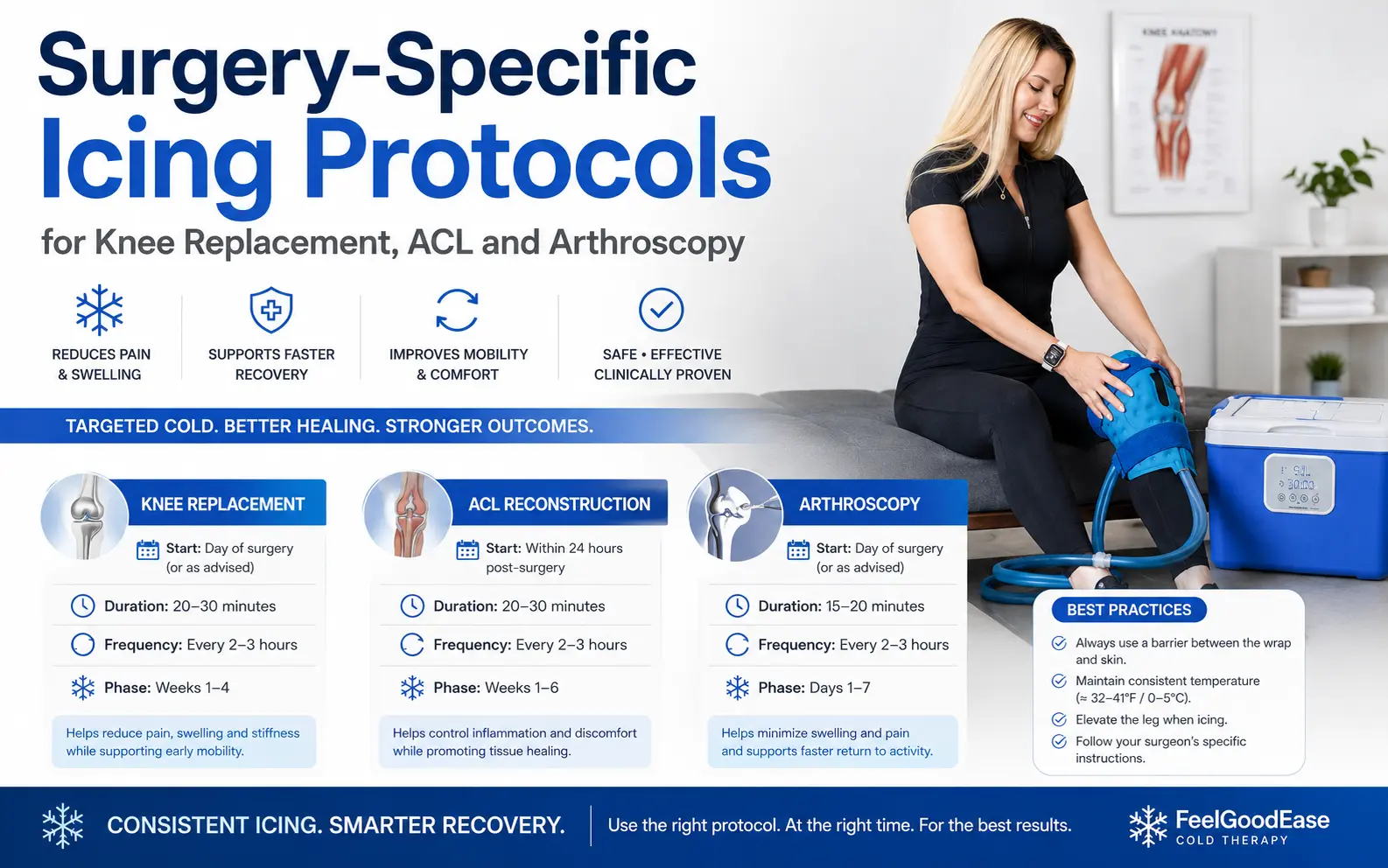

Surgery-Specific Icing Protocols for Knee Replacement, ACL and Arthroscopy
It’s 2 a.m. and your knee is screaming. The ice machine’s reservoir is lukewarm, the dressing feels damp and the discharge papers offer nothing but “ice and raise.” You’re exhausted in pain and suddenly unsure whether you’re helping your healing or quietly making things worse.
I’ve had patients call me in exactly this situation thinking something went wrong with the surgery. But in most cases, the issue isn’t the knee.
It’s the protocol. Cold therapy isn’t just about using ice it’s about using it correctly.
Knee replacement, ACL reconstruction and arthroscopy all require different approaches. Treating them the same way often leads to more pain, slower recovery and unnecessary confusion.
Key Takeaways
Icing protocols are not one-size-fits-all total knee replacement, ACL reconstruction and arthroscopy each require different schedules.
Continuous cooling is typically appropriate only for the first 48-72 hours and only with strict skin checks. After that switch to intermittent 20-minutes-on/off cycles.
Always use a thin cloth barrier and check skin every 15-20 minutes frostbite and nerve injury are real risks.
Pairing cold therapy with elevation above heart level reduces swelling faster than either alone.
Call your surgeon immediately if skin stays white or numb for more than 30 minutes after icing, sudden unrelieved pain occurs or you see signs of infection.
Generic icing advice is dangerous precisely because it ignores what makes your surgery unique. A total knee replacement swells differently than an ACL reconstruction a simple scope doesn’t need the same aggressive cooling as a joint full of hemarthrosis.
When instructions are vague, patients default to “more is better,” leaving ice on bare skin for hours, soaking dressings and mistaking rebound swelling for a sign they should ice even longer. The result is frostbite, skin maceration and a cycle of pain that drives unnecessary opioid use.
This guide replaces those one-line discharge instructions with surgery-specific, phase-based cryotherapy plans. You’ll learn exactly when to start cooling, how long each session should last, how to protect your incision and when to stop and call your surgeon. Never ice bare skin. That’s the first rule and every protocol that follows is built to keep you safe while cutting swelling and pain at the source.
Now, let’s ground every instruction in the physiology that makes cold therapy work, so you understand why these protocols matter not just what to do.
Why Cold Therapy Works: The Physiology Behind Post-Operative Cooling
Before you set a timer or unwrap a gel pack, you need to know what cold actually does to a freshly operated knee. It’s not just about numbing the skin. Cold triggers a chain of physiological responses that directly limit swelling, protect struggling cells and quiet the pain signals racing to your brain. Understanding these mechanisms will make the protocols that follow feel less like arbitrary rules and more like a deliberate strategy.
Vasoconstriction and the Inflammatory Cascade
Surgery sets off a local fire alarm. Damaged tissues release inflammatory mediators that make blood vessels leaky, allowing fluid and cells to pool in the surrounding space. That pooling is vasoconstriction’s target.
Applying cold causes the smooth muscle in vessel walls to contract, narrowing the channels and slamming the door on further fluid escape. Less fluid leakage means less edema and less edema means less pressure on sensitive nerve endings. The result is a direct, mechanical reduction in pain.
Cold numbs the skin, but it also actively reduces the biological chaos inside your joint.
Slowing Cellular Metabolism to Protect Healing Tissue
The first 48 hours after surgery are a low-oxygen crisis. Swelling compresses capillaries and the surgical trauma itself disrupts blood flow, leaving cells starved for oxygen. If those cells keep running at full metabolic speed, they burn through their limited energy reserves and die, expanding the injury zone.
Lowering tissue temperature slows that metabolic demand to a crawl. Cells enter a kind of protective hibernation, conserving energy and surviving until circulation returns. This is why early, consistent cooling matters you’re buying time for the tissue that will eventually rebuild your knee.
The Pain Gate Theory: Why Numbing the Nerve Actually Blocks Pain Signals
Pain isn’t a simple wire from knee to brain. At the spinal cord, a gating mechanism decides which signals get through. Sharp, fast-conducting cold sensations compete with slower, duller pain signals for the same neural bandwidth. When cold stimuli flood the gate they effectively close it to the aching throbbing messages from your joint.
This means you get relief even if the cold doesn’t feel intensely cold. The competition happens at the spinal level not in your conscious perception. It’s a neurological trick that works alongside the physical reduction of swelling.
What the Clinical Evidence Actually Shows
The physiology is compelling, but you deserve to know that the numbers back it up. A Cochrane systematic review of cryotherapy after total knee replacement found that patients who used cold therapy gained 8.3 degrees more knee flexion and reported pain scores 1.6 points lower on a 0-10 scale at two days post-op.
Those aren’t just comfort metrics; extra flexion early on means you can start strengthening sooner and walk with a more normal gait. The same review noted little concern for serious adverse events. These findings anchor every protocol in this guide. We’re not passing along folklore.
In practice, I see this reflected clearly. Patients who apply cold therapy consistently tend to present with noticeably less swelling and bruising in early follow-ups which directly improves their ability to regain movement and tolerate rehabilitation.
That physiology is why cold works. But the internet’s advice on how to apply it is a mess. Next, we’ll resolve the conflicting rules you’ve already encountered.
The Icing Paradox: Resolving Conflicting Advice After Knee Surgery
You’ve probably heard “20 minutes on, 20 minutes off” a hundred times. That rule wasn’t written for a knee with fresh internal sutures and a drainage tube.
The advice patients actually receive after surgery is a mess of contradictions: one nurse says ice constantly, the discharge sheet says 20 minutes every two hours and a well-meaning neighbor swears by frozen peas for 10 minutes only.
This section cuts through the noise by focusing on what actually matters protocols that match the real physiology of a healing surgical knee.
Instead of generic ice therapy for sore muscles, this guide breaks down surgery-specific protocols for knee replacement, ACL reconstruction and arthroscopy. It also includes practical setup guidance and safety considerations for both patients and caregivers areas that are often overlooked in standard recovery instructions.
Continuous vs. Intermittent Cooling: When Each Makes Sense
In the first 48 hours after surgery, your knee is fighting a wave of acute inflammation and, in some cases, bleeding into the joint space (hemarthrosis).
Recent meta-analyses comparing continuous and traditional cryotherapy after total knee replacement support continuous cooling during this early phase for better pain control and less swelling.
A systematic review of cryotherapy protocols found that automated devices can safely run for up to 48 hours continuously. Intermittent ice-pack protocols typically cycle 10 to 20 minutes on with breaks in between.
Continuous cooling keeps the tissue temperature low enough to sustain vasoconstriction and slow the metabolic cascade that drives edema. Intermittent cooling lets the tissue rewarm, which can allow a rebound of fluid and inflammatory signals.
For the first two days, set a motorized unit to a steady, moderate temperature and let it run.
After that initial window, when the swelling curve flattens, switch to intermittent sessions, 30 minutes on, at least 30 minutes off, to protect the skin and so you can move around for meals and bathroom trips.
Continuous cooling in the first 48 hours is safe at home if you follow a simple 30-minute skin-check protocol. Lift the pad, look at the skin underneath and confirm it’s pink, dry and free of white or mottled patches. If the dressing is damp, swap it for a dry one immediately moisture trapped under a cold pad leads to maceration and skin breakdown.
I often walk caregivers through this during early recovery. One routine I recommend especially for overnight use is setting a quiet timer every 30 minutes. A quick check is enough: lift the pad inspect the skin and reposition it if it has shifted. I’ve seen cases where the pad gradually moved off the target area during sleep, reducing effectiveness while increasing the risk of uneven cooling.
If the dressing feels damp, change it immediately. If the skin looks pale, patchy or overly cold, pause the cooling and allow the area to return to normal before restarting. These small checks take less than a minute but they prevent most of the issues I see with continuous cold therapy at home.
Debunking the Rigid “20-Minute Rule” in Early Recovery
The 20-minute rule comes from sports medicine, where an ice pack sits directly on bare skin over a sprained ankle. Surgical dressings and the closed-loop pads of a motorized cryotherapy unit change the safety profile entirely. The dressing acts as a thermal buffer and the pad circulates water at a controlled temperature rather than delivering sub-freezing gel. You are not risking frostbite the same way.
That doesn’t mean you can ignore skin checks. It means the decision isn’t a timer; it’s a visual inspection. Here’s a step-by-step guide for the first 48 hours:
- Set the device to the temperature your surgeon or PT recommends usually 45°F to 55°F for continuous use.
- Every 30 minutes, lift the pad and inspect the skin through the dressing. Look for normal color, no excessive redness and no fluid leaking through the bandage.
- If the skin looks pale, blotchy or numb, stop cooling for 30 minutes and call your surgeon’s office if it doesn’t return to normal.
- If the pad shifts off the joint and onto the shin or thigh, reposition it. Cooling the wrong area wastes the effect and can chill muscles you need for early mobility.
The 30-minute skin-check protocol is what makes extended cooling safe not a stopwatch set to 20 minutes.
Surgery-Specific Nuances: Replacement, ACL and Arthroscopy
Not all knee surgeries create the same internal mess. A total knee replacement involves cutting bone, placing implants and disrupting the joint lining, which triggers deep bleeding and a massive inflammatory response. That deep tissue trauma demands longer continuous cooling, often the full 48 hours to control hemarthrosis and reduce opioid use.
An ACL reconstruction tunnels through bone and harvests a graft but the joint surface itself isn’t replaced. The inflammation is still significant, but the graft’s early survival depends on a delicate blood supply. Overly aggressive cooling could theoretically compromise graft healing. For that reason, many surgeons prefer continuous cooling for the first 24 hours, then intermittent sessions with a 30-minute-on, 30-minute-off rhythm.
Arthroscopy for a meniscus trim or loose body removal is the least invasive. The incisions are small, the internal trauma is superficial and swelling typically peaks within 24 hours.
Continuous cooling for the first night is often enough after that intermittent gel packs or a motorized unit on a 20-minute cycle work well. The skin around those tiny portal incisions is more exposed.
Keep the dressings dry and check the skin every 20 minutes if you’re using a gel pack directly over them.
Now that you know when to ice continuously and when to back off, let’s compare the tools that deliver that cold from $15 gel packs to $400 motorized units.
Cold Therapy Methods Compared: Finding What Works for Your Recovery
The right tool depends on your surgery, your budget and who’s helping you at home. Here’s the honest breakdown.
Motorized Cryotherapy Systems
A motorized unit is a closed-loop system that pumps chilled water through a pad wrapped around your knee, holding a steady 45-50°F for hours. That consistency matters most in the first 48 hours, when continuous cold can shrink the risk of hemarthrosis (bleeding into a joint space) and cut opioid use. Most units include an auto-shutoff and a timer, plus a dedicated power adapter, so you can sleep without waking to swap a pack.
The trade-off is cost. Rental rates run $35 to $100 per week and buying a unit outright ranges from $130 to $400. Insurance coverage is unpredictable some plans cover rental as durable medical equipment others don’t. Ask your surgeon’s office if they bundle a unit with surgery, include a replacement hose tube, or have a preferred DME provider.
That single call can drop your weekly rental by $50 or more. If insurance won’t pay, a two-week rental is still cheaper than a single ER visit for uncontrolled swelling.
Reusable Gel Packs and Compression Wraps
Gel-based wraps that conform to the knee are affordable and portable. You can buy a pair for $20 to $50 and rotate them from freezer to knee, or purchase a replacement knee wrap separately. The compression they add helps move edema (swelling caused by fluid trapped in tissues) out of the joint and they’re easy to secure with built-in straps.
The downside is temperature fade. A gel pack loses meaningful cooling power in 20 to 30 minutes, so you need a disciplined rotation and a helper who can swap them on schedule. Condensation is another headache the outer fabric gets damp and if that moisture reaches your dressing, you risk maceration (softening and breakdown of skin from prolonged moisture). Always wrap the pack in a dry barrier cloth and check the dressing after each session.
Standard Ice Packs and DIY Alternatives
A bag of crushed ice or a sack of frozen peas is accessible in a pinch but it’s a temporary bridge not a plan. Ice bags leak. Frozen vegetables thaw unevenly and leave hot spots. Neither stays put on a moving knee and the constant repositioning disturbs your rest.
Worse, meltwater can soak through dressings and macerate the skin around your incision. If you must use a DIY pack, double-bag it, wrap it in a towel and set a timer for 15 minutes, then check your skin immediately.
Immersion Methods and Their Limitations After Knee Surgery
Filling a tub with ice water and submerging the whole leg sounds thorough but it’s rarely safe early on. Until the wound is fully sealed and scab-free, usually two to three weeks never submerge an unhealed incision any soak invites infection.
Even after the incision closes, getting in and out of a cold tub with a post-surgical knee is a fall risk and the sudden cold can trigger a vasovagal response (sudden drop in heart rate and blood pressure). Reserve immersion for later-stage rehab and only with your surgeon’s explicit clearance.
At-a-Glance: Choosing Your Method by Recovery Phase
| Method | Best Recovery Phase | Pros | Cons | Estimated Cost |
|---|---|---|---|---|
| Motorized Cryotherapy Unit | First 48 hours (acute phase) | Consistent 45-50°F, hands-free, reduces hemarthrosis and opioid need | Higher cost, insurance variability, requires setup | $35-$100/week rental $130-$400 purchase |
| Reusable Gel Packs with Compression Wraps | Early to mid recovery (days 3-10) | Affordable, portable, adds compression | Fades in 20-30 min, condensation risk, needs disciplined rotation | $20-$50 per pair |
| Standard Ice Packs / DIY Methods | Late recovery, temporary bridge only | Accessible, zero cost in a pinch | Leaks, uneven cooling, hard to secure, can macerate dressings | $5-$10 for reusable ice bags |
| Cold Water Immersion | Late-stage rehab (2-3+ weeks, incision fully sealed) | Covers whole limb, can combine with gentle motion | Infection risk if incision unhealed, fall hazard, vasovagal trigger | Free (requires tub) |
Rental rates and insurance coverage vary widely by region and DME provider. Some hospitals bundle a motorized unit into the surgical discharge package. Ask before surgery.
You’ve picked your method. Now let’s walk through exactly how to use it safely, session by session.
Use continuous cooling for the first 48 hours, preferably with a motorized unit, to maximize blood loss reduction and pain relief.
Transition to intermittent 20-minute sessions after 48 hours and taper to activity-only icing by week 3.
TKR patients may need extended continuous cooling (up to 72 hours) due to higher bleeding risk; ACL patients must protect the graft site from direct cold pressure.
Check skin under the dressing every 30 minutes during continuous cooling even if you can’t feel the area.
Track pain and swelling daily to guide your phase transitions: don’t rely on time alone.
Cold therapy controls swelling and pain but it’s not the only tool. Next, we’ll look at how to use it to cut opioid reliance and make physical therapy more effective.
Managing Pain and Swelling Without Relying Solely on Medication
Pain medication has its place, but a well-timed ice pack can do what a pill cannot shrink the swelling that’s causing the pain in the first place. Pills mask the signal. Cold therapy goes after the source the fluid buildup stretching every tissue layer around your knee. When you understand that difference, you stop treating ice as a comfort measure and start using it as a primary pain-control tool.
How Cold Therapy Reduces Post-Operative Edema
Cold triggers vasoconstriction, the narrowing of blood vessels and slows metabolic activity inside the tissues. That dual effect reduces the amount of fluid leaking into the joint and surrounding soft tissue, directly shrinking edema (swelling caused by fluid trapped in tissues). Less fluid means less pressure on nerve endings and that translates to lower pain scores without a single milligram of medication.
The evidence on heat vs cold therapy backs this up.
A Cochrane systematic review of cryotherapy (therapeutic application of cold) after total knee replacement found that consistent icing reduced pain by 1.6 points on a 0-10 scale at two days and improved knee flexion by over 8 degrees. Those gains aren’t random.
They come from less hemarthrosis (bleeding into the joint space) and less soft-tissue swelling exactly what cold therapy is designed to control. When the knee isn’t fighting against its own fluid, it bends further and hurts less.
In practice, I often show patients this in a very simple way. Measure your knee circumference before icing, then again after a 15-20 minute session you’ll usually see a visible reduction. That immediate change reinforces what’s happening internally and helps patients stay consistent with their protocol.
That physiology is why cold works. But the internet’s advice on how to apply it is inconsistent at best. Next, we’ll break down the conflicting rules you’ve likely already come across.
Timing Icing to Improve Physical Therapy Compliance
The window right before physical therapy is the most valuable icing session of your day. A cold knee moves with less pain and less pain means you’ll push into the range-of-motion work that determines how fast you regain function. The same Cochrane review that showed better flexion with cryotherapy also points to why reduced edema lets the joint capsule and muscles stretch without triggering a protective spasm.
Here’s a sample morning schedule that locks this in. Wake up, check your dressing is dry and apply cold for 20 minutes.
Then do your first set of prescribed exercises immediately after while the numbing effect is still active and the swelling is at its daily low.
Many patients who dread the morning PT session find it tolerable even productive, once they commit to that pre-session ice block. Never skip the pre-PT icing session. It’s the single highest-leverage habit for early flexion gains.
One patient who struggled with heel slides in the first week started a consistent 20-minute pre-PT icing routine within a few sessions, their pain during movement dropped and they began hitting flexion milestones they had been stuck on.
That’s not coincidence. Reducing swelling before loading the joint changes how the knee responds to movement.
Reducing Opioid Dependence Through Consistent Cooling Protocols
Post-operative pain that drives opioid use is overwhelmingly edema-driven. When you keep swelling in check with a structured icing schedule, you attack the reason you’re reaching for the pill bottle. Patients who ice consistently often find they need far fewer narcotic doses and the ones they do take become backup not the default.
That shift matters because opioids bring their own complications sedation that makes you unsteady on crutches, constipation that adds misery to an already difficult recovery and a fog that blunts your motivation to move. Cold therapy has none of those side effects.
In one case, a patient was able to cut their opioid use by more than half within the first two weeks simply by following a consistent icing routine. The difference wasn’t just in pain control it showed up in how they moved how alert they felt and how actively they participated in rehab.
Cold therapy for arthritis pain also solves a problem pills can’t touch nighttime pain. A 20-minute session right before sleep can quiet the throbbing enough to let you rest without a middle-of-the-night dose, keeping your head clearer for the next day’s rehab.
Cold therapy is powerful but it has a sharp edge.
Safety Deep-Dive: When Cold Therapy Becomes Dangerous
I’ve seen frostbite on a post-op knee exactly once. That was one time too many. Read this section carefully.
Cold therapy is a powerful tool but it demands respect. The line between therapeutic vasoconstriction and tissue injury is thinner than most patients realize. This section teaches you to read your skin protect your incision and recognize when cold therapy is not safe for you at all.
Normal Numbness vs. Frostbite and Nerve Injury
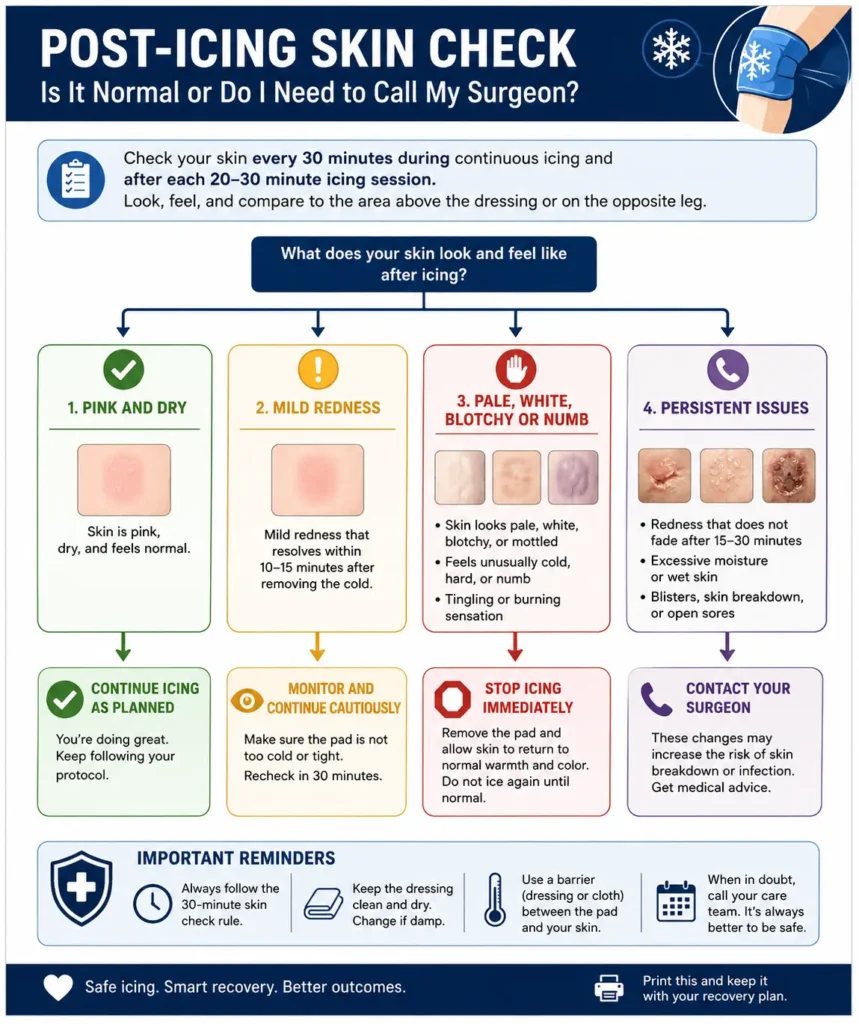
After you remove the cold source your skin should look pink or slightly red. That color fades within ten minutes as blood flow returns. A brief superficial numbness is normal. What is not normal is skin that stays white, waxy or blotchy after ten minutes, or numbness that persists beyond twenty minutes. Those are early frostbite signals.
The mechanism is straightforward. Cold causes vasoconstriction narrowing surface blood vessels to reduce swelling. If the cold is too intense or applied too long that constriction starves the tissue of oxygen. The skin then stiffens loses sensation and can develop blisters. You will not feel the damage happening which is why the clock and a visual check matter more than your comfort level.
Make the ten-minute skin check a non-negotiable habit. Lift the cold source, dry the skin gently and look. If you see persistent white patches a hard or waxy texture or blistering, stop all cold therapy and call your surgeon’s office. Do not reapply ice until you have spoken to a clinician.
Protecting Your Incision: Moisture Barriers and Dressing Integrity
Moisture is the enemy of a healing incision. Even a small amount of condensation can cause maceration the softening and breakdown of skin that opens a door to infection. Your dressing must stay dry throughout every icing session.
Follow these steps every time:
- Inspect the dressing before you start. It should be clean, dry and fully sealed at the edges.
- Place a dry cloth barrier between the cold source and your skin. A clean kitchen towel or a purpose-made fabric sleeve works. Never apply an ice pack or gel pack directly to the dressing and never directly to bare skin.
- After icing, remove the barrier and check the dressing immediately. Look for damp spots, lifted edges or any fluid seeping through.
- If the dressing is wet, pat it dry with a clean cloth and call your surgeon’s office for guidance. A compromised dressing often needs a sterile change not a home repair.
This routine adds thirty seconds to your session and prevents weeks of wound trouble.
Some pre-existing conditions make standard cold therapy dangerous. The evidence is clear patients with peripheral neuropathy, Raynaud’s syndrome, cold urticaria or vascular insufficiency face a sharply higher risk of frostbite and tissue injury. If you have any of these, you need a modified protocol or explicit surgeon clearance before you ice.
Peripheral neuropathy, common in diabetes, dulls sensation. You cannot rely on discomfort to warn you, so a silent burn can progress to full-thickness damage. Raynaud’s syndrome causes exaggerated vasospasm in fingers and toes cold exposure can trigger a painful attack and further reduce blood flow.
Vascular insufficiency means your baseline circulation is already compromised, leaving little reserve when cold constricts vessels. Cold urticaria is a rare condition where cold triggers hives, swelling and in severe cases, anaphylaxis.
If your chart includes any of these terms, do not assume cold therapy is safe. Ask your surgeon directly. A modified approach might involve shorter durations, warmer temperatures or a different modality altogether.
Overnight Protocols and Caregiver Monitoring
Never sleep with a static ice pack on your knee. This is the single most preventable cause of severe post-operative frostbite. While you sleep, you cannot feel the cold deepening and a gel pack that felt fine at 10 p.m. can cause irreversible damage by 2 a.m.
Safe overnight cooling requires an auto-shutoff device. Motorized cold therapy units with built-in timers cycle off after a set period, typically 20 or 30 minutes. If you use one, confirm the shutoff is working before you settle in. A caregiver should set an alarm to check your skin once during the night even with an auto-shutoff unit. The check takes ten seconds: lift the pad, look at the skin, confirm it is pink and dry and replace the barrier.
If you do not have an auto-shutoff unit, do not ice while you sleep. Ice during waking hours and rely on elevation and compression overnight instead. A caregiver can apply a fresh cold pack for a timed 20-minute session if the patient wakes but never leave it in place unattended.
Cold therapy works best when it’s part of a trio ice, elevation and compression. Let’s put them together.
Integrating Cold Therapy with Elevation, Compression and Rehabilitation
Ice alone is good. Ice plus elevation is better. Ice plus elevation plus compression is the gold standard, when done right. This section shows you how to stack these tools in the right order and how to time them around your physical therapy sessions so you get the most swelling control with the least risk.
The Synergistic Effect of Elevation Plus Cooling
Elevation above heart level doubles the edema-reducing effect of cold by adding gravity-assisted drainage. Cold causes vasoconstriction, limiting fresh fluid from entering the joint. But without elevation, the fluid that’s already there just sits. When you raise the leg so the knee is higher than your heart, gravity pulls that pooled fluid back toward your core where your lymphatic system can clear it. The combination is not additive; it’s synergistic.
Positioning is simple but precise. Lie flat on a couch or bed. Stack pillows under your calf and ankle, never directly under the knee joint itself. That can block drainage and even promote a flexion contracture.
The knee should be straight or slightly bent but the ankle must be higher than the knee and the knee higher than your heart. Check by placing a hand on your chest: if your knee is above that level, you’re good. Then apply the cold wrap or machine pad. Stay in this position for the full icing cycle. Getting up too soon undoes the drainage work.
Scheduling Icing Around Physical Therapy Sessions
Pre-cool for 20 to 30 minutes before your PT session. It numbs the joint enough to push through stiffness without masking injury pain. You want the analgesic effect to make movement tolerable but you still need to feel sharp, unfamiliar pain that signals you’re doing too much.
A dull ache that eases with motion is normal. A sudden stabbing sensation is not. If you can’t tell the difference, you’ve over-iced.
After the session, post-PT icing is non-negotiable. Every loaded movement, heel slides, quad sets, partial weight-bearing, triggers a micro-inflammatory response. If you don’t cap that spike immediately, you’ll walk into the next day stiffer and more swollen than you were.
Apply cold within 15 minutes of finishing PT and keep it on for the full prescribed duration. This one habit cuts the need for breakthrough pain medication more than most patients realize.
Compression and Cold: When to Pair Them and When to Pause
Compression wraps amplify cold’s vasoconstriction by mechanically squeezing superficial vessels, driving the cooling deeper. Together they can shrink swelling faster than either alone. But compression is a tool with a sharp edge.
The sequence matters. Raise first, then ice, then wrap. Never compress a limb you haven’t checked for swelling. If the leg is already puffy, wrapping can create a tourniquet effect.
Once the wrap is on, check your toes every 10 minutes. They should be pink and warm. If they tingle, turn dusky or feel numb in a way that’s different from the cold itself, loosen the wrap immediately. That’s a circulation red flag not a comfort issue.
For overnight use, skip compression entirely. Your sensation is dulled during sleep and you won’t notice a problem until it’s serious. Cold alone with the leg raised and the dressing dry is the safer nighttime protocol.
You’ve got the protocols. Now let’s make sure you have the right gear and know how to get it without breaking the bank.
The right equipment separates a protocol you follow from one you abandon because it is too much hassle. You already know how to layer cold with elevation and compression. Now we will get the gear into your hands cut through the insurance red tape and build a tracking system your surgeon actually wants to see.
Motorized Units: Purchase, Rental and Insurance Conversations
A motorized cold therapy unit circulates chilled water through a pad that wraps your knee. It delivers steady, controlled cooling for hours without the constant swapping gel packs demand. Rental costs run from about $35 to $100 per week. Buying outright ranges from $130 to $400. Some hospitals bundle the unit into the surgical package. Ask your surgeon’s office before you pay out of pocket.
Insurance coverage is inconsistent but it is not impossible. The key is prior authorization that speaks the insurer’s language.
Document failed conservative management.
Your documentation must clearly show that basic gel packs failed to control post-operative edema. It should establish that a motorized cold therapy unit is medically necessary to reduce complications such as hemarthrosis, limited range of motion or increased reliance on opioids.
In one case following total knee replacement, coverage was approved after the surgeon’s office submitted a prior authorization note with specific language:
“Patient demonstrates persistent post-operative edema unresponsive to passive cold therapy. Swelling is limiting early range of motion and functional rehabilitation. A motorized cold therapy unit is medically necessary to provide consistent, controlled cryotherapy and reduce risk of complications including hemarthrosis and delayed mobility.”
That level of clarity makes the difference. General statements get denied specific functional limitations get approved.
If insurance denies coverage, ask about a cash-pay rental rate through the hospital’s durable medical equipment partner. In many cases, that rate is significantly lower than standard retail pricing.
Product Recommendation
For safe and effective home cryotherapy, a structured setup matters more than any single tool:
- Motorized cold therapy unit for continuous, controlled cooling
- Reusable gel packs with compression wraps for flexibility
- Waterproof incision barrier to protect surgical sites
- Wedge pillow for proper elevation
- Digital timer to maintain safe intervals
- Thin cotton barrier to protect the skin
- Non-contact skin thermometer for monitoring
This combination supports consistency, safety and better recovery outcomes at home.
Gel Packs, Wraps, Barriers and Elevation Aids Worth Owning
Even if you secure a motorized unit, keep a backup set of reusable gel packs with integrated compression wraps. They are portable, require no electricity and let you ice while moving from bed to chair. Look for wraps with adjustable straps that hold the pack snug against the joint without cutting off circulation.
A waterproof incision barrier is essential. It keeps the dressing dry during icing sessions and prevents the maceration that leads to wound breakdown. Pair it with a thin cotton barrier, a single layer of clean, dry fabric between the cold source and your skin, to protect against frostbite while still allowing effective heat transfer.
Elevation matters as much as the cold itself. A wedge pillow positions your leg above heart level. You will not have to stack couch cushions that slide apart at 2 a.m. It is a simple tool that makes every minute of cryotherapy count.
A digital timer removes the guesswork. Set it for your prescribed icing duration and stop when it beeps. You will not miss the mark because you fell asleep.
Keep a daily recovery log. Record icing start and stop times. Note pain scores on a 0-10 scale, a quick swelling severity rating (mild/moderate/severe) and a one-line note on skin condition after each session.
Add any unusual symptoms: new redness, warmth that persists after icing or a sudden spike in pain.
This log turns subjective sensations into objective data your care team can act on. At your first follow-up, hand over a sheet of numbers instead of a vague “it has been pretty swollen.” That data flags complications early. It helps your therapist adjust the protocol without guesswork.
You have the knowledge and the gear. The last piece is a set of printable aids that turn this guide into a daily habit.
Phase-Based Recovery Checklist: From PACU to Week Six
This is a single-sheet, day-by-day tracker that converts the article’s phase protocols into a morning-and-evening routine.
Each day gets its own row with checkboxes for the non-negotiables: icing sessions (time started, duration, skin inspected), pain score (0-10) and a simple swelling grade: mild, moderate, or severe.
There’s a column for the one PT milestone that matters most that week (straight-leg raise, full extension, first steps without crutches) and a small equipment notes field where you jot “water topped off” or “dressing dry.”
The checklist lives on the fridge. Your phone will die, your brain will fog. A paper you can mark with a pen removes the mental load of tracking.
You don’t have to remember when you last iced; the checklist does it for you. It also gives your surgeon or PT a concrete log to review at follow-ups, turning subjective “I think I iced enough” into objective data.
Red Flag vs. Normal Sensation: A Quick-Reference Flowchart
Print this flowchart and post it right next to the checklist. It’s a yes/no decision tree that starts with one box: Icing session complete. From there, you check skin color and sensation. The normal branch skin is pink, cool to the touch and any mild numbness fades within ten minutes. That’s expected vasoconstriction the narrowing of blood vessels that reduces swelling. Action: resume icing per your schedule.
The danger branch: skin stays mottled, white or waxy after rewarming; numbness persists or deepens; you feel burning pain or see blisters. Stop icing immediately. Keep the limb raised and call your surgeon. The flowchart uses plain language and large arrows so a caregiver can follow it in seconds, even at 2 a.m. It removes the guesswork that leads to either undertreating swelling or ignoring early cold injury.
We’ve covered the phases, the tools and the warning signs. Let’s close with a word for the person helping you through this and the red flags that override everything.
Conclusion
If you’ve made it this far, you’re either the patient or the person who loves them enough to read 3,000 words about ice. Either way, thank you. The protocols you just walked through are not generic advice.
They are surgery-specific, phase-based schedules built to reduce edema, protect fragile incisions from maceration and keep you off opioids when pain can be managed with cold instead. Now the real work shifts from reading to doing.
That’s where a caregiver becomes the most important person in the room.
A Final Word for Caregivers and Family Members
You are the eyes and hands when the patient cannot check their own skin. Set up the motorized cryotherapy unit before the patient comes home fill the reservoir with ice and water, run the hose so it won’t kink when the leg moves and place the control switch within reach of the patient’s hand on the non-surgical side.
When you reposition the leg, slide your hands under the calf and heel. Never grab the dressing or the knee itself. A careless tug can shift the wound closure and invite infection.
Overnight skin checks are non-negotiable but you don’t need to wake the patient. Use a small flashlight to lift the edge of the cooling pad and inspect the skin for persistent white blotches, blisters or a numb, waxy look. If the skin looks normal tuck the pad back and let them sleep. If anything looks off, stop the machine and let the tissue rewarm.
The phase-based schedules in this guide are designed to be taped to the fridge not memorized. Follow the one that matches your surgery exactly knee arthroscopy, ACL reconstruction or total knee replacement because the risk of hemarthrosis and the safe icing duration are not the same across procedures.
When to Call Your Surgeon Immediately
You now have a checklist not just advice. Use it to advocate for the patient during follow-up calls and, more critically to know when waiting until morning is dangerous. Three red flags demand an immediate call to the surgeon’s office or after-hours line.
First, sudden, unrelieved pain that breaks through the cold and prescribed medication. This isn’t the expected ache of early rehab. It’s a sharp, escalating signal that may point to compartment syndrome or a deep bleed. Second any sign of infection: spreading redness beyond the incision edges, foul-smelling drainage or a fever over 100.4°F. Cryotherapy can mask early warmth so check the skin when the pad is off.
Third, skin that stays white, numb or blistered more than 30 minutes after you stop icing. That’s not normal vasoconstriction. It’s a cold injury. Document what you see, note the time and call.
Early detection of these changes prevents complications that delay rehab and increase opioid reliance. You’ve got the protocol. Now trust your eyes.
Trust & Sourcing
The protocols in this article are based on Cochrane systematic reviews and AAOS guidelines and were medically reviewed by a licensed physical therapist to ensure you’re getting current, evidence-based guidance.
Frequently Asked Questions (FAQs)
It depends on the surgery. For total knee replacement, use continuous cooling for the first 48-72 hours then switch to intermittent 20-30 minute sessions. For ACL reconstruction, continuous cooling for 24 hours then 30 minutes on/off. For arthroscopy, continuous cooling the first night, then intermittent. Always check skin every 30 minutes during continuous use.
Never sleep with a static ice pack; it can cause frostbite. Only use a motorized unit with an auto-shutoff timer and have a caregiver check your skin once overnight. If you don’t have an auto-shutoff unit, do not ice while sleeping.
Skin that stays white, waxy or blotchy after 10 minutes of rewarming, numbness that persists beyond 20 minutes or blisters. Stop icing immediately and call your surgeon.
Both. Ice for 20-30 minutes before PT to reduce pain and make movement easier. Ice immediately after PT to control the micro-inflammatory response and prevent next-day stiffness.
Always place a dry cloth barrier between the cold source and your skin or dressing. Never apply ice directly to bare skin or the dressing. After each session, check that the dressing is dry and intact; if damp, pat dry and call your surgeon’s office for guidance.
Call immediately if skin stays white or numb more than 30 minutes after stopping ice, if you have sudden unrelieved pain or if you see signs of infection like spreading redness, foul drainage or fever over 100.4°F. Also, if you have conditions like peripheral neuropathy or Raynaud’s get explicit clearance before icing.
