🚚 Free Shipping (3-5 Business Days) | 🛡️ 30-Day Money-Back Guarantee | 🏆 6-Month Warranty | ⭐ Trusted by 1000+ Happy Customers
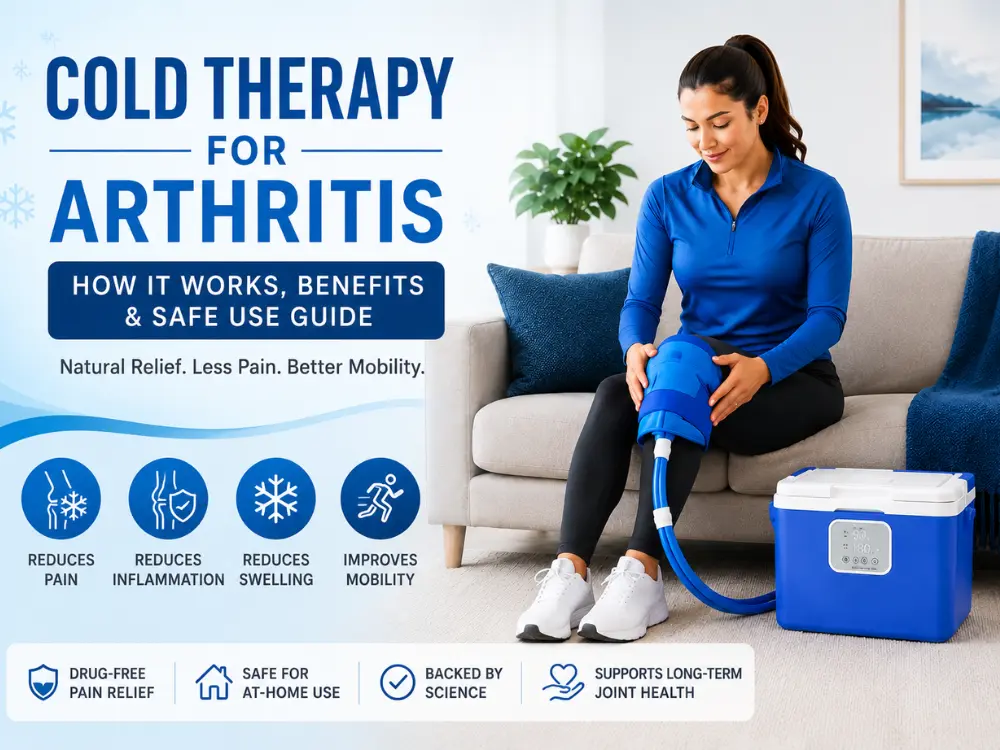

Cold Therapy for Arthritis: How It Works, Benefits & Safe Use Guide
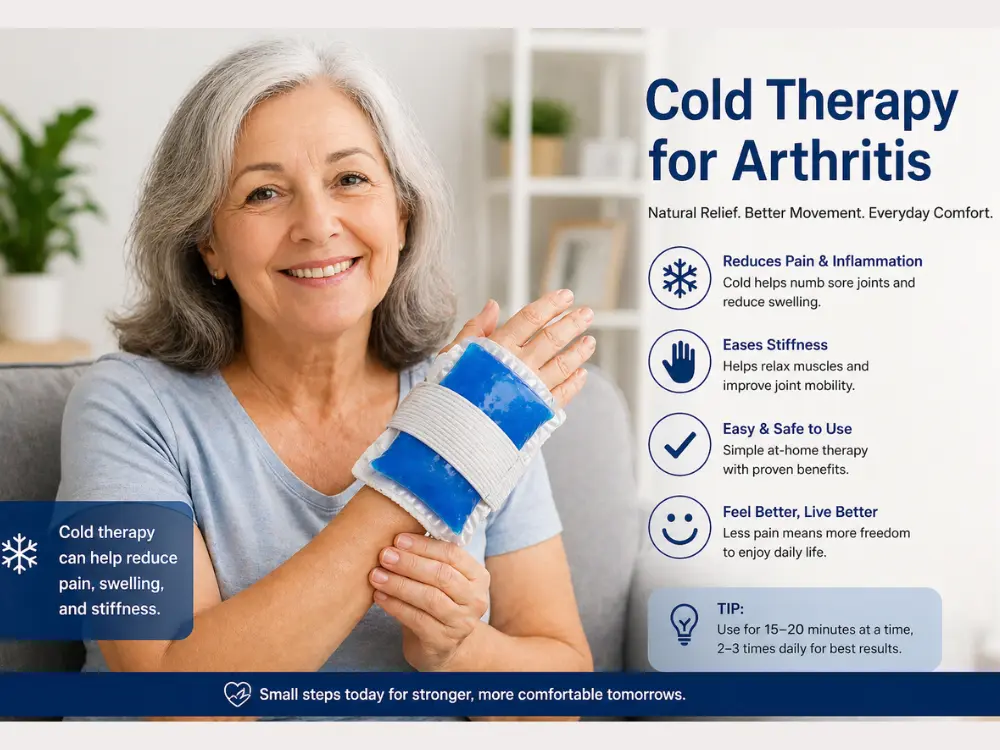
Cold therapy (cryotherapy) helps manage arthritis by reducing inflammation, slowing pain signals and easing joint stiffness making movement more comfortable and predictable when used correctly.
I’ve worked with many patients who quietly adjust their lives around joint pain. Arthritis doesn’t just cause discomfort it changes how you move, how long you stay active and even how you plan simple daily tasks.
Getting out of bed, climbing stairs or holding objects can gradually become difficult when stiffness and inflammation take over.
One pattern I see repeatedly is this: people feel stuck between relying on medication and simply pushing through the pain. While medication can help it doesn’t always provide consistent relief and over time, concerns about long-term use start to build.
That’s usually when patients begin looking for something safer and more manageable at home.
From a recovery perspective this is where cold therapy for arthritis becomes highly effective.
Cold therapy also known as cryotherapy or ice therapy works by calming inflamed tissues, reducing swelling and lowering pain sensitivity in affected joints. It’s one of the most practical and clinically supported ways to control arthritis symptoms without adding stress to the body.
However, the problem isn’t a lack of effectiveness.
In my experience most people simply aren’t shown how to use cold therapy correctly. They:
- apply ice for too long
- use it at the wrong stage of pain
- or expect immediate results without consistency
This often leads to frustration and the assumption that cold therapy doesn’t work.
This guide is designed to fix that.
You’ll learn:
- how cold therapy works for inflammation and pain
- when to use ice for arthritis symptoms
- how long and how often to apply it safely
- and how to avoid common mistakes
More importantly, you’ll understand how to make it part of a consistent routine so relief becomes reliable not occasional.
Everything shared here is based on clinical understanding of tissue response to cold along with what I’ve seen work in real recovery scenarios.
Note: This content is for educational purposes only and is not a substitute for professional medical advice. If you have underlying health conditions or severe symptoms consult your healthcare provider before starting cold therapy.
How Cold Therapy Works: The Science Behind the Chill for Arthritis Relief
Cold therapy works by reducing inflammation slowing pain signals and limiting swelling making it highly effective for arthritis pain relief and joint stiffness.
In arthritis, the real problem isn’t just pain it’s chronic inflammation inside the joint.
The body responds as if there’s an injury:
- blood flow increases
- fluid builds up
- the joint becomes swollen, warm and stiff
This internal pressure is what causes that deep, aching discomfort and restricted movement especially after activity or long periods of rest.
In my experience, patients often focus only on pain without realizing that inflammation is the root driver behind most of their symptoms.
Physiological Mechanisms of Cold Therapy
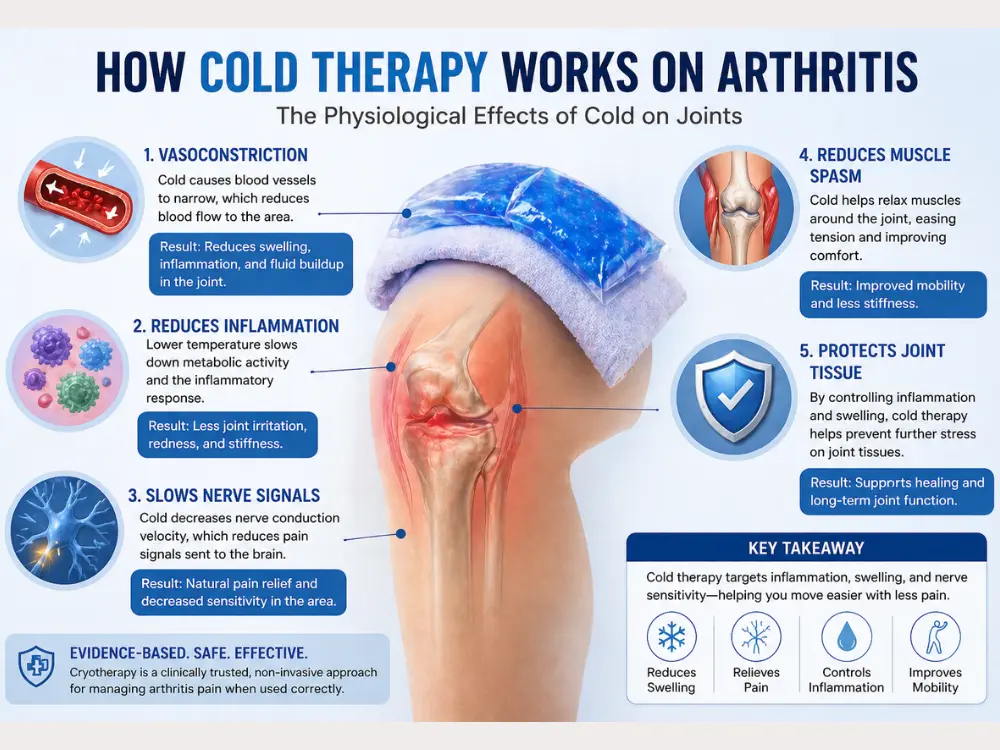
Cold therapy (cryotherapy) reduces inflammation and pain by constricting blood vessels, slowing nerve signals and lowering tissue activity in the affected joint.
From a clinical standpoint, this is what makes cold therapy for arthritis so effective it directly targets how the body responds to irritation.
Vasoconstriction (Reduced Blood Flow)
When cold is applied blood vessels tighten a process known as vasoconstriction.
This helps:
- reduce swelling and inflammation
- limit fluid accumulation in the joint
- ease that tight, pressurized feeling
This is why ice for inflammation works so well particularly in visibly swollen joints like knees or fingers.
Nerve Impulse Reduction (Pain Signal Slowing)
Cold also slows how nerves transmit pain signals to the brain.
As a result:
- pain intensity decreases
- the area feels slightly numb
- discomfort becomes more manageable
A simple way to understand this: It’s like turning down the volume on pain not eliminating it completely but making it easier to tolerate. This explains why ice therapy for pain often provides quick noticeable relief.
Metabolic Rate Decrease (Reduced Tissue Stress)
Inflamed tissues are highly active they’re essentially overstimulated.
Cold therapy reduces this activity, which helps:
- prevent further irritation
- limit secondary tissue damage
- control the inflammatory response
From a recovery perspective this is key. It stops inflammation from escalating instead of just reacting to it later.
Muscle Spasm Reduction (Improved Joint Comfort)
When a joint is inflamed surrounding muscles often tighten to protect it.
Cold therapy helps relax this response which:
- reduces pressure around the joint
- improves comfort during movement
- supports better mobility
I’ve seen this particularly in back and knee arthritis where muscle tension adds to joint pain.
Key Benefits of Cold Therapy for Arthritis Symptoms
Cold therapy (cryotherapy) helps reduce arthritis pain, control inflammation and improve joint comfort making it easier to move and stay active without relying only on medication a principle also applied for recovery after knee procedures.
Direct Pain Reduction
Cold therapy provides quick pain relief by slowing nerve signals and reducing sensitivity in the affected joint.
In real recovery scenarios this is often the first noticeable benefit. When applied correctly ice therapy for pain can calm flare-ups within minutes.
It doesn’t treat the root condition but it creates a window where movement feels easier and less restricted. For someone dealing with constant discomfort even temporary relief can significantly improve daily function.
Decreased Swelling and Inflammation
Cold therapy reduces swelling by limiting blood flow and fluid buildup inside the joint. This is where cold therapy for inflammation becomes especially effective.
Swollen joints feel tight, heavy and difficult to move. By controlling that internal pressure cold application helps the joint feel lighter and more responsive.
In my experience, once swelling decreases patients often notice immediate improvement in comfort even before pain fully settles.
Reduced Muscle Spasms
Cold therapy helps relax surrounding muscles reducing protective tightness around inflamed joints.
When a joint is irritated nearby muscles tighten to protect it. This adds another layer of stiffness and discomfort.
Applying cold helps calm this response which is particularly useful in areas like:
- knees
- lower back
- shoulders
This is where cryotherapy for joint pain supports not just the joint but the surrounding tissue as well.
Improved Joint Mobility (Indirect Benefit)
By reducing pain and swelling cold therapy makes movement easier even though it doesn’t directly increase flexibility.
This distinction is important.
Cold therapy creates the right conditions for movement by:
- lowering pain levels
- reducing joint pressure
- easing stiffness
As a result, patients often find it easier to:
- bend joints
- perform light activity
- engage in gentle exercises
This is why cold therapy for arthritis works best when combined with movement not used in isolation.
Non-Pharmacological Approach
Cold therapy offers a natural drug-free way to manage arthritis symptoms safely at home.
Many patients I’ve worked with are concerned about long-term medication use either due to side effects or limited results.
Cold therapy provides a practical alternative. It allows you to manage arthritis pain and inflammation without adding additional strain on the body.
From a safety perspective this makes it a reliable long-term strategy.
Accessibility and Cost-Effectiveness
Cold therapy is simple, affordable and easy to use making it one of the most accessible pain management tools.
You don’t need specialized equipment to start:
- ice packs
- frozen vegetables
- basic cold wraps
All can be effective when used correctly.
What matters most is consistency. In my experience, patients are far more likely to stick with cold therapy at home when it fits easily into their routine without cost or complexity becoming a barrier.
When to Reach for Cold: Identifying the Right Time and Conditions
Cold therapy is most effective when inflammation, swelling or joint irritation is active such as during arthritis flare-ups or after physical activity.
In my experience, timing is where most people get it wrong. They either use ice therapy for pain too late or apply it when the joint isn’t actually inflamed.
Knowing when to use cold therapy for arthritis makes a noticeable difference in how well it works.
Here are the situations where it delivers the best results:
Acute Flare-ups
When pain suddenly increases and the joint feels warm, swollen or irritated.
This is when inflammation is most active and cryotherapy for pain relief can help calm it quickly and prevent it from worsening.
Post-Activity Inflammation
After walking, exercise, physiotherapy or prolonged standing.
If the joint feels aggravated afterward applying cold therapy for inflammation can help control swelling before it builds up further.
Visible Swelling or Joint Pressure
If the joint looks puffy or feels tight due to fluid buildup.
This is where cold compress for swelling becomes highly effective in reducing internal pressure and discomfort.
Morning Stiffness (Selective Use)
Cold can help only if stiffness is linked to mild inflammation.
However, if the joint feels stiff but not swollen or warm, cold may not be the right choice and could make movement feel more restricted.
Crucial Contraindications (When NOT to Use Cold Therapy)
Cold therapy should be avoided in conditions where circulation is impaired or skin sensitivity is reduced as it may increase the risk of tissue damage and specific considerations apply for cold therapy during pregnancy.
From a safety perspective, this is critical. I’ve seen patients unintentionally worsen symptoms simply because they applied cold without considering underlying conditions.
Avoid cryotherapy treatment in the following cases:
- Impaired Circulation
Conditions like Raynaud’s phenomenon, peripheral artery disease or advanced diabetes can worsen with cold exposure - Nerve Damage or Neuropathy
Reduced sensation makes it difficult to detect excessive cold or skin irritation - Open Wounds or Skin Lesions
Cold can delay healing and increase infection risk - Cold Sensitivity or Allergy
Some individuals react negatively even to mild cold exposure - Application Over Large Areas
Can lower overall body temperature and should be avoided - Stiffness Without Inflammation
Cold is not effective here and may increase discomfort
Expert Tip: Understand contraindications avoid cold therapy if you have impaired circulation, nerve damage or open wounds.
Understanding Cold vs. Heat Therapy
Use cold therapy for swelling and inflammation and heat therapy for stiffness and tight muscles without active inflammation.
This is one of the most common areas of confusion I see.
Cold Therapy → Best for:
- Inflammation
- Swelling
- Arthritis flare-ups
- Post-activity irritation
Heat Therapy → Best for:
- Muscle stiffness
- Chronic tightness
- Joints that feel rigid but not swollen
In real recovery scenarios a combined approach can sometimes work well.
For example:
- Heat to loosen stiffness
- Cold to control inflammation afterward
But this should always be adjusted based on how your body responds.
Expert Tip: Consider combining cold therapy with gentle movement or alternating with heat when appropriate always under professional guidance.
Your Home Toolkit: Types of Cold Therapy for Arthritis Relief
You can manage arthritis pain effectively at home using simple cold therapy tools like ice packs, effective compression wraps or even frozen vegetables when used correctly and consistently.
In my experience results don’t depend on having the “best” tool they depend on choosing something practical and using it the right way.
The ideal method should:
- match the joint you’re treating
- target inflammation effectively
- fit easily into your daily routine
Reusable Gel Ice Packs
Product Recommendation: Reusable Gel Ice Packs (various sizes)
These are one of the most dependable options for cold therapy for arthritis and general joint pain.
Pros:
- Conforms well to joints like knees, shoulders and wrists
- Provides steady cooling for cryotherapy for inflammation
- Reusable and easy to store
Cons:
- Can feel stiff when fully frozen
- May leak if damaged
Practical Tip: Always use a cloth barrier. Keeping multiple packs ready helps maintain consistency in your cold therapy at home routine.
Frozen Vegetable Bags (e.g., peas, corn)
Product Recommendation: Frozen Vegetable Bags (e.g., peas, corn for conformity)
This is one of the simplest and most flexible ways to apply ice therapy for pain.
Pros:
- Easily molds around uneven joints
- Affordable and widely available
- Effective for cold compress for swelling
Cons:
- Doesn’t stay cold as long as gel packs
- Can leak if packaging breaks
From what I’ve seen, this option is often overlooked but for quick, adaptable cold treatment for pain it works surprisingly well.
Cold Compression Wraps
Product Recommendation: Cold Compression Wraps (e.g., elastic bandages with gel inserts)
These are especially useful for larger joints like knees.
Pros:
- Combines cold with compression for better swelling control
- Supports cold compression therapy knee effectively
- Hands-free and easy to keep in place
Cons:
- Can feel bulky
- Needs careful adjustment to avoid restricting circulation
From a clinical standpoint combining compression with cold can enhance results particularly when swelling is persistent.
Ice Massage Tools (e.g., ice cups, roller balls)
Product Recommendation: Ice Massage Tools (e.g., ice cups, roller balls)
These are best for targeted areas and localized discomfort.
Pros:
- Precise application for specific pain points
- Useful for cryotherapy for muscle pain around joints
- Can help reduce localized stiffness
Cons:
- Requires active use
- May feel intense if used too long
Practical Tip: Use in short, controlled sessions. This method works best for targeted ice therapy for arthritis pain not large joint areas.
Cold Baths / Immersion
Cold immersion is an effective form of cryotherapy at home for reducing inflammation and joint pain especially when multiple joints are affected at once.
In my experience patients with arthritis in the hands or feet often find ice packs limiting because the discomfort isn’t localized. That’s where immersion becomes more useful it provides even cold exposure across a wider area.
Pros:
- Effective for cryotherapy for joint pain affecting multiple small joints
- Helps reduce inflammation and swelling more evenly
- Useful for cold therapy for arthritis in hands and feet
Cons:
- Can feel uncomfortable initially
- Risk of overexposure if timing isn’t controlled
- Not suitable for those with high cold sensitivity
From a recovery standpoint, the goal isn’t extreme cold it’s controlled cold exposure that calms inflammation without stressing the tissue.
Expert Tip: For larger areas or diffuse pain cold immersion can be useful but keep water moderately cold and limit duration to safe intervals.
Essential Support Tools
Support tools play a key role in making cold therapy safe, controlled and effective especially when used regularly at home.
In real recovery scenarios these small additions often prevent the most common mistakes.
Insulated Towels / Wraps
Product Recommendation: Insulated Towels/Wraps (for skin protection)
Always use a barrier between ice and skin to prevent irritation or cold-related damage.
Why it matters:
- Protects skin during ice therapy for pain
- Makes cold compress for pain relief safer
- Helps maintain controlled temperature during cryotherapy treatment
One of the most frequent issues I see is direct ice application. It doesn’t improve results it increases risk.
Digital Timer
Product Recommendation: Digital Timer (for safe application durations)
Timing is critical most cryotherapy side effects happen due to overuse not underuse.
Why it matters:
- Helps control how long to leave an ice pack on
- Prevents excessive exposure during cold therapy at home
- Keeps cryotherapy for pain relief consistent
I always advise patients to avoid guessing. Structured timing leads to better and safer outcomes.
Thermometer (Optional, for Advanced Monitoring)
Product Recommendation: Thermometer (for monitoring skin temperature, if needed)
For those managing long-term symptoms monitoring temperature can add an extra layer of safety.
Why it matters:
- Helps regulate exposure during cryogenic therapy
- Useful if you’re concerned about is cryotherapy safe
- Adds precision for sensitive or chronic conditions
This isn’t essential for most people but it can be helpful in more controlled recovery setups.
Step-by-Step Guide: Safely Applying Cold Therapy to Specific Joints
Safe cold therapy depends on proper timing, skin protection and monitoring this is what makes cryotherapy effective without causing harm.
Most problems with cold therapy at home don’t come from the method itself they come from small mistakes like overuse, direct skin contact or poor timing or issues with essential machine components.
Getting these basics right makes a significant difference in how effective and safe ice therapy for pain actually is.
Use a Barrier (Protect Your Skin)
Always place a cloth or towel between the cold source and your skin.
Applying ice directly to the skin is a common mistake. It doesn’t improve results instead, it increases the risk of irritation or mild frostbite especially with repeated use.
Expert Tip: Always use a barrier (towel or cloth) between the cold pack and your skin to prevent frostbite or skin damage.
Follow Proper Duration (15-20 Minutes Maximum)
Apply cold therapy for 15-20 minutes at a time no longer.
Longer sessions don’t improve cryotherapy for pain relief. In fact, excessive exposure can slow circulation too much and become counterproductive.
This is particularly important when managing inflammation and swelling.
Expert Tip: Limit cold application to 15-20 minutes at a time longer durations can be harmful rather than helpful.
Allow Recovery Time Between Sessions
Wait at least 2-4 hours before reapplying cold therapy.
Tissues need time to return to their normal state. Without this gap repeated exposure can irritate the area instead of calming it.
This step is essential for effective cold therapy for inflammation.
Expert Tip: Allow 2-4 hours between sessions to let the skin and underlying tissue normalize.
Monitor Your Skin Response
Pay attention to how your skin reacts during and after application.
Watch for:
- excessive redness
- prolonged numbness
- tingling or burning sensations
- any blistering
These are early signs that the cold exposure may be too intense.
Expert Tip: If you notice unusual skin reactions or increased discomfort stop immediately and reassess before continuing.
Stay Within Comfort Limits
Cold therapy should ease discomfort not create new pain.
A mild cooling or numbing sensation is expected. But sharp pain, deep aching or lingering numbness means the application needs to be adjusted.
Your body gives clear feedback pay attention to it.
Focus on Common Arthritis-Affected Joints
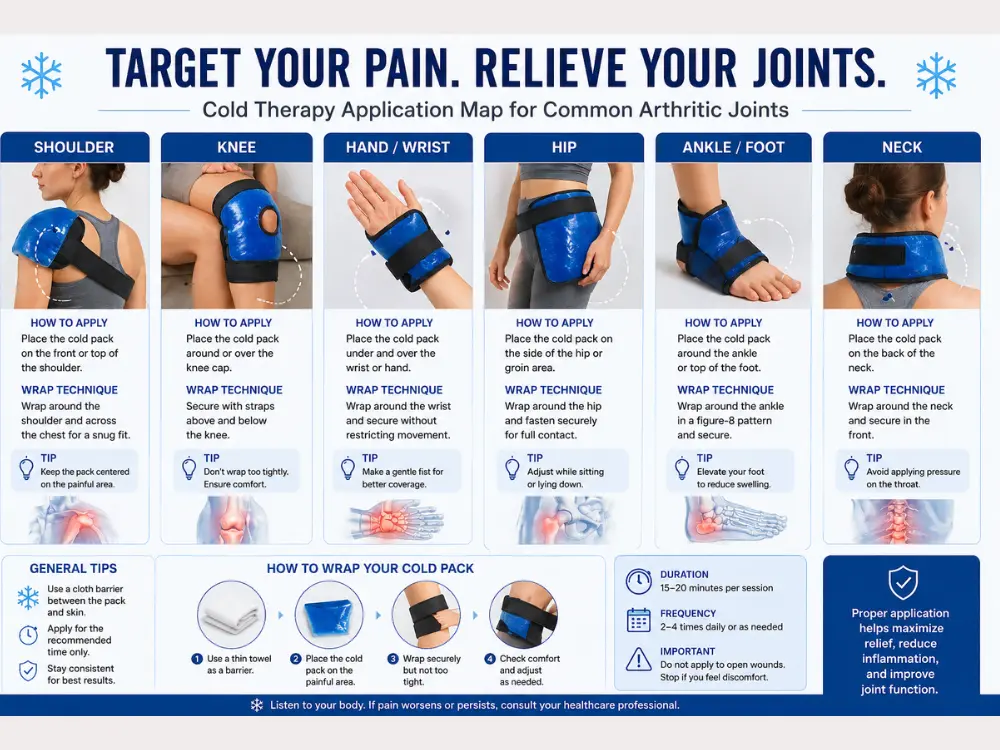
Correct placement of cold therapy is essential targeting the right area helps reduce inflammation, improve pain relief and make cryotherapy more effective for arthritis.
A common issue I’ve seen is not the use of ice therapy for pain but where it’s applied. Even slight misplacement can reduce the impact especially when trying to control swelling.
Knee
For knee arthritis, place cold packs above and below the kneecap to target the joint space where swelling builds.
This positioning helps reduce inflammation and fluid buildup making it particularly effective for cold compression therapy knee.
- Use a wrap to hold the pack in place
- Avoid concentrating cold in one spot
- Keep the knee slightly elevated if swelling is present
This approach works well for ice for knee pain especially after activity.
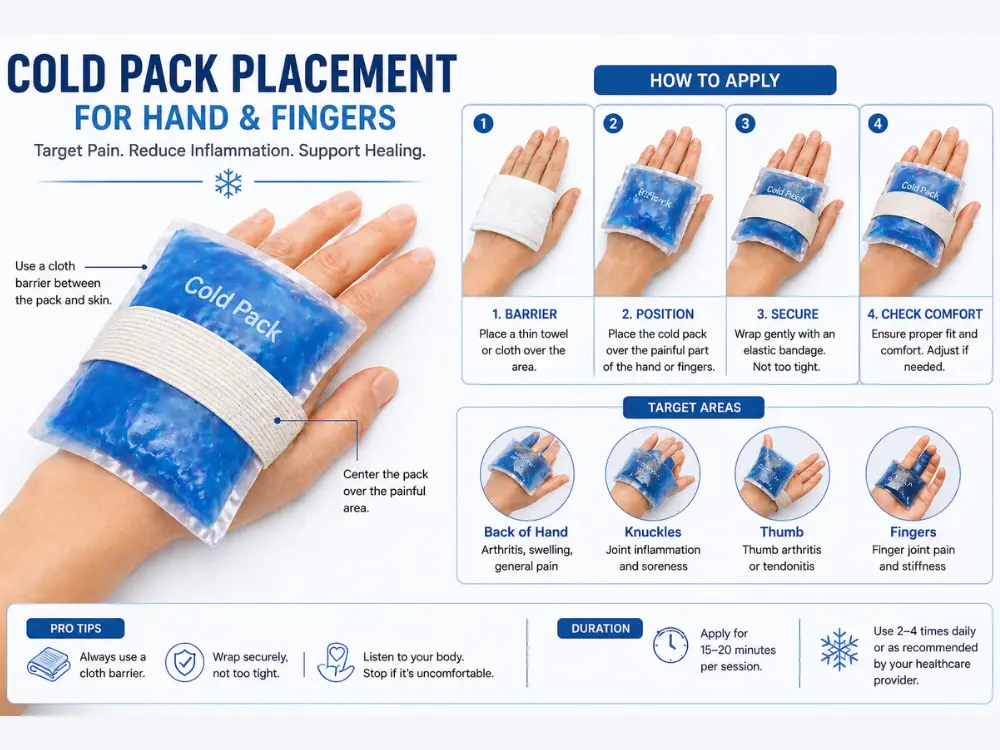
Hand / Fingers
Use flexible cold therapy methods that can conform closely to small joints.
Best options include:
- Gel packs
- Frozen vegetable bags
- Cold immersion (for multiple joints)
This is especially useful for cryotherapy for arthritis affecting several finger joints at once.
Soft, flexible options tend to provide better coverage than rigid packs, particularly when joints are uneven or swollen.
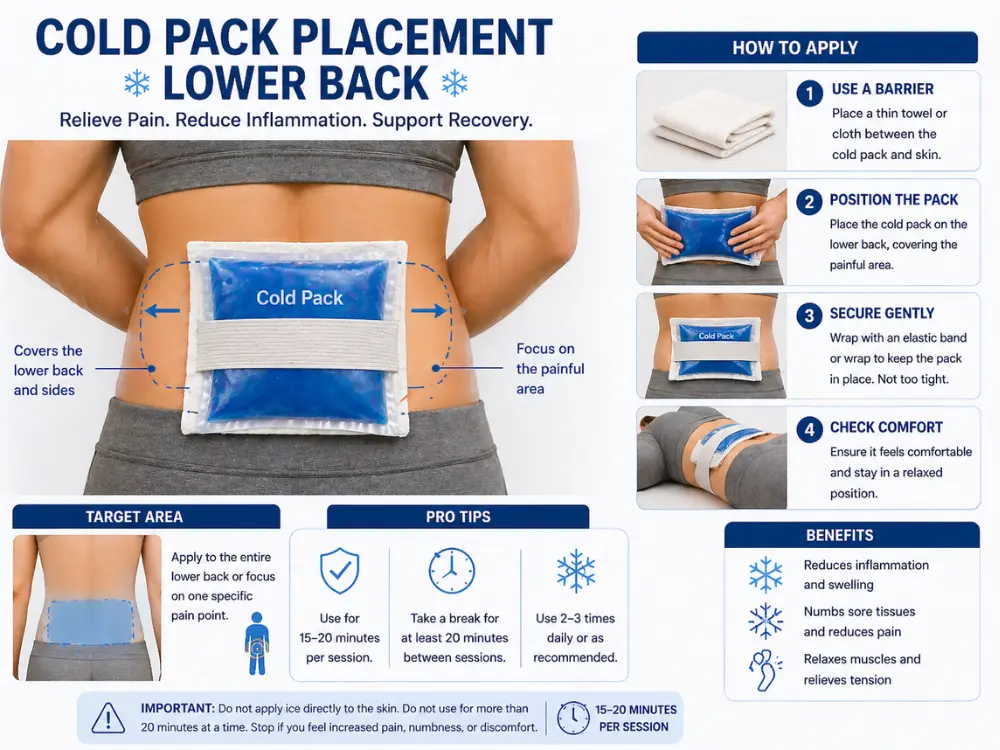
Back (Lower / Upper)
For back pain, use larger cold packs that can cover a broader surface area along the spine.
- Position the pack along the lower or upper back based on pain location
- Sit or lie in a supported position
- Avoid uneven pressure on the spine
This method works well for cryotherapy for back pain and cold compression for back pain especially after prolonged sitting or standing.
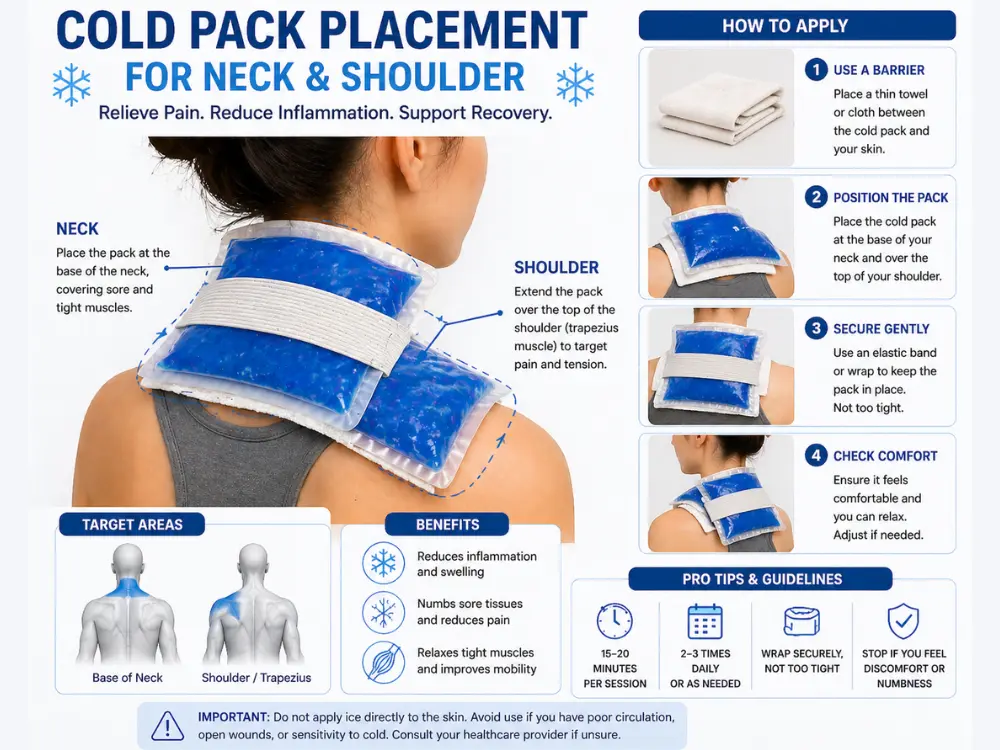
Neck / Shoulder
Use flexible packs that can gently wrap around the neck or rest over the shoulder joint.
- Keep the position relaxed
- Avoid excessive pressure
- Limit duration as this area is more sensitive
This approach helps manage joint pain and muscle tension in the upper body.
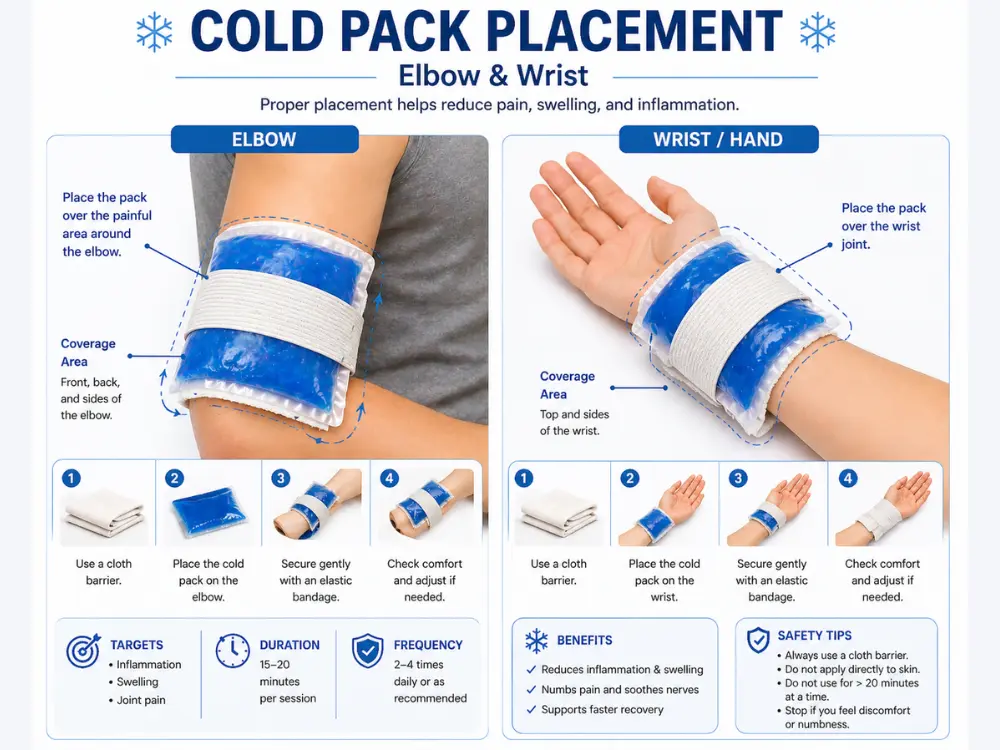
Elbow / Wrist
Apply cold therapy in a targeted way around smaller joints where inflammation is localized.
- Use smaller gel packs or wraps
- Avoid direct pressure on bony areas
- Adjust placement for comfort
This is effective for ice therapy for joint pain in sensitive areas like the wrist or elbow.
Post-Application Care
Proper aftercare helps maintain the benefits of cold therapy and prevents unnecessary irritation.
- Gently dry the skin if needed
- Allow the area to return to normal temperature
- Avoid immediate intense activity
Giving the joint time to settle after cold therapy for pain relief supports better recovery and reduces the chance of flare-ups.
Common Mistakes to Avoid While Using Cold Therapy
Most cold therapy mistakes come from overuse, poor timing or incorrect application fixing these can significantly improve pain relief and prevent skin or tissue damage.
Direct Skin Contact
Applying ice directly to the skin can cause irritation, burns or even mild frostbite always use a protective barrier.
A common misconception is that direct contact makes ice therapy for pain more effective. In reality, it increases the risk of skin damage without improving results.
A simple cloth or towel allows you to use cold therapy for pain relief safely while still getting the full benefit.
Over-Application (Too Long or Too Frequent)
Using cold therapy for too long or too often can reduce its effectiveness and delay recovery.
There’s a tendency to think more is better but with cryotherapy treatment that approach often backfires.
- Exceeding 15-20 minutes can trigger a rebound increase in blood flow
- Frequent back-to-back sessions can irritate tissue
- Skipping recovery time reduces effectiveness
This is one of the most common reasons cold therapy for inflammation doesn’t deliver expected results.
Ignoring Contraindications
Cold therapy is not suitable for everyone certain conditions increase the risk of complications.
Extra caution is needed if you have:
- circulation issues
- nerve damage or neuropathy
- severe diabetes
- cold sensitivity
In these cases, cryotherapy for pain relief can reduce blood flow too much and create additional risk if not used carefully.
Using Too Much Pressure
Excessive compression can restrict circulation and reduce the benefits of cold therapy.
This often happens when using wraps or systems for cold compression therapy.
- The wrap should feel secure not tight
- Tingling, numbness or throbbing are warning signs
- Normal circulation should always be maintained
Too much pressure can cancel out the intended effect of reducing inflammation.
Expecting a “Cure”
Cold therapy manages symptoms it does not cure arthritis or reverse joint damage.
This is an important expectation to set early.
Cold therapy helps by:
- reducing inflammation
- slowing pain signals
- improving comfort temporarily
But arthritis is a long-term condition. Expecting cryotherapy for arthritis to permanently fix the problem often leads to frustration.
Expert Tip: Cold therapy is a supportive tool it helps control symptoms but it should always be part of a broader arthritis management plan.
Integrating Cold Therapy into Your Daily Arthritis Management Routine
Consistency is Key
Cold therapy works best when used consistently regular application helps control inflammation, reduce pain and make relief more predictable over time.
Using cold therapy for arthritis only during severe pain often leads to inconsistent results. The real benefit comes when it’s applied at the right time and repeated regularly.
Simple ways to build consistency:
- After daily activity (walking, chores, exercise)
- During flare-ups of joint pain and swelling
- At a fixed time each day (e.g., evening routine)
This approach turns cryotherapy for pain relief into a dependable part of your routine rather than a last-minute solution.
Complementary Treatment (Not a Standalone Solution)
Cold therapy should support your overall arthritis plan not replace other treatments.
The most effective outcomes come from combining:
- cold therapy for inflammation
- prescribed medication (when needed)
- gentle movement or physiotherapy
- supportive lifestyle habits
Cold therapy helps reduce pain and swelling which makes it easier to stay active and follow other recovery strategies including supportive stretching and exercise equipment.
Differentiation Opportunity: Cold therapy works best as part of a broader management plan not as a standalone fix.
Expert Tip: Integrate cold therapy into your overall routine rather than using it in isolation.
Tracking Your Progress: “My Cold Therapy Diary”
Tracking your sessions helps you understand what actually works so you can improve results over time.
For long-term conditions like arthritis small adjustments make a big difference. Keeping a simple record helps identify patterns in cryotherapy treatment effectiveness.
How to use it:
- Log date and time of application
- Note how long to ice and the method used
- Rate pain before and after (1-10 scale)
- Observe changes in swelling or stiffness
- Record any discomfort or side effects
Why it helps:
- Identifies what improves cold therapy at home results
- Helps refine your routine
- Provides useful insights for healthcare discussions
Unique Element: “My Cold Therapy Diary” template
Expert Tip: Keeping a simple log can quickly show which timing and methods work best for your body.
Setting Realistic Expectations
Cold therapy provides temporary relief it helps manage symptoms not cure arthritis.
This is where many people feel frustrated simply because expectations aren’t clear from the beginning.
- Relief can start quickly but varies from person to person
- Results are temporary and require consistency
- Mild discomfort during application can be normal initially
The goal isn’t instant or permanent relief it’s steady, predictable control of pain and inflammation that improves daily function.
Differentiation Opportunity: Clear expectations help avoid frustration and improve long-term consistency.
“My Journey”: A Personal Story of Finding Relief with Cold Therapy
Cold therapy didn’t remove arthritis but it gave me control over pain and inflammation in a way I hadn’t experienced before.
Before: Living Around the Pain
Arthritis doesn’t usually take over all at once it builds slowly.
For me, it started with stiffness in my hands and occasional discomfort in my knees. At first, it was easy to ignore. But over time it became part of my daily routine.
- Mornings meant tight fingers and slower movement
- Sitting too long led to stiffness in my lower back
- Even simple tasks like typing or walking longer distances became uncomfortable
What made it harder wasn’t just the pain it was the unpredictability. Some days felt manageable others didn’t. And like many people I was cautious about depending too much on medication.
Turning Point: Discovering Cold Therapy
I was already familiar with cold therapy for inflammation but I hadn’t been using it in a structured way.
The shift came when I stopped treating it as a quick fix and started using it more intentionally for arthritis pain and swelling.
I began applying cryotherapy at home:
- after activity
- during flare-ups
- with better timing and consistency
Initial Experience: What I Noticed First
The first few sessions of ice therapy for pain weren’t completely comfortable. That initial cold sensation takes some getting used to.
But within minutes, I noticed small changes:
- the deep aching pain started to ease
- pressure in swollen areas reduced
- stiffness felt less intense
It wasn’t dramatic but it was reliable. And that consistency stood out.
Integration: Making It Part of My Routine
This is where the real difference happened.
Instead of using cold therapy occasionally, I made it part of my routine:
- gel packs for my knees after walking
- cold application for my hands after long periods of typing
- cold compression therapy when swelling increased
At first, it required some adjustment especially getting the timing right. But over time, it became easier to follow.
What changed wasn’t just the method it was the consistency. That’s what made cryotherapy for pain relief feel dependable.
After: What Changed
Gradually, things started to shift.
- Movement felt smoother
- Flare-ups became easier to manage
- I could stay active longer without discomfort building up
Small improvements made a big difference walking more comfortably, working without constant stiffness and getting through the day without focusing on pain all the time.
Cold therapy didn’t “fix” arthritis but it helped me manage it proactively instead of reacting to it.
A Realistic but Hopeful Takeaway
You don’t need to eliminate arthritis to improve your quality of life you need consistent ways to manage it.
Cold therapy is one of those tools.
When used correctly, it can:
- reduce inflammation
- improve comfort
- support daily movement
More importantly, it gives you back a sense of control something many people feel they’ve lost.
Myth vs. Fact: Debunking Common Misconceptions About Cold Therapy
Cold therapy works best when used correctly misunderstanding how cryotherapy works often leads to poor results, overuse or unnecessary frustration.
Many people assume cold therapy doesn’t help arthritis when in reality it’s often being used the wrong way.
Myth 1: Cold therapy will heal my arthritis
Fact: Cold therapy manages symptoms like pain and inflammation it does not cure arthritis or reverse joint damage.
Arthritis involves long-term changes in the joint. What cryotherapy treatment does is control how your body responds reducing swelling, calming irritation and easing discomfort.
That alone can make movement easier and improve daily function significantly.
Myth 2: The colder, the better and for as long as possible
Fact: Excessive cold or prolonged use can damage the skin and may even increase inflammation.
More isn’t better here.
- Too much cold can irritate tissue
- Long exposure can reduce circulation too much
- It may trigger a rebound increase in blood flow
Effective cold therapy for pain relief is controlled not extreme.
Myth 3: Cold therapy is only for acute injuries
Fact: Cold therapy is also highly effective for managing chronic inflammation in arthritis.
While commonly used for injuries cryotherapy for arthritis helps:
- reduce ongoing inflammation
- manage swelling after activity
- control flare-up pain
In practice, it’s one of the most useful tools for day-to-day symptom management.
Myth 4: It’s okay to apply ice directly to the skin
Fact: Direct ice contact can cause irritation or mild frostbite always use a barrier.
This is a critical safety rule in ice therapy for pain.
Without protection:
- skin irritation can occur quickly
- risk of cold-related injury increases
- sensitivity may worsen over time
A simple cloth layer makes cold compress for pain relief both safe and effective.
Myth 5: Cold therapy and heat therapy cannot be used together
Fact: Cold and heat can be used strategically depending on the type of symptoms.
- Cold therapy → inflammation, swelling, flare-ups
- Heat therapy → stiffness, tight muscles
In some cases, alternating between the two can be helpful for example heat to loosen stiffness followed by cold to control inflammation.
This should always be adjusted based on how your body responds.
Frequently Asked Questions (FAQs) About Cold Therapy for Arthritis
Cold therapy can be used 2-3 times daily with 2-4 hours between sessions and each session lasting 15-20 minutes.
Spacing is just as important as duration. This allows tissues to recover and keeps cold therapy for inflammation effective without overexposure.
Yes, cold therapy is generally safe alongside most arthritis medications but it’s best to confirm with your doctor.
It works well as a complementary approach cryotherapy for pain relief can reduce symptoms without interfering with medication.
Stop immediately. Persistent redness or numbness means the cold exposure was too intense or too long.
Allow the area to return to normal temperature. If symptoms continue seek medical advice before using ice therapy for pain again.
Cold therapy is generally safe for all ages but older adults should use extra caution.
Reduced skin sensitivity or circulation can increase risk so shorter sessions and proper skin protection are especially important for safe cold therapy for arthritis.
Cold therapy can help manage symptoms in most types of arthritis including osteoarthritis and rheumatoid arthritis.
It is most effective for:
- reducing inflammation
- controlling swelling
- providing temporary pain relief
Results vary depending on the condition and severity.
No, sleeping with an ice pack is not safe and should be avoided.
Prolonged, uncontrolled exposure increases the risk of skin damage, frostbite and circulation issues. This is one of the most common mistakes in cold therapy at home.
Important Medical Disclaimer and When to Consult Your Doctor
Medical Disclaimer
This content is for informational and educational purposes only and is not a substitute for professional medical advice, diagnosis or treatment.
Cold therapy (cryotherapy) is widely used to manage arthritis pain and inflammation but its effectiveness and safety depend on individual health conditions.
This guide is designed to help you understand how to use cold therapy for arthritis correctly. However, it should not replace guidance from a qualified healthcare professional.
You should always consult your doctor or healthcare provider:
- before starting any new treatment including cryotherapy at home
- if you have questions about your specific condition
- if you are unsure whether cold therapy is appropriate for you
When to Consult a Doctor
Seek medical advice if your symptoms change, worsen or do not improve with cold therapy.
Consult a healthcare professional if:
- you have pre-existing medical conditions
- arthritis pain becomes more severe or behaves differently
- you experience side effects such as prolonged numbness, skin irritation or increased pain after ice therapy for pain
- you have conditions like diabetes, poor circulation or nerve damage
- you need a structured plan to safely integrate cold therapy into your treatment
Early guidance can help prevent complications and ensure safe use.
My Credentials & Medical Review
This guide is based on clinical understanding, real-world recovery experience and established medical principles.
With over 15 years of experience in the global healthcare industry including work with Medtronic and Johnson & Johnson I’ve seen how properly applied cold therapy for pain relief can support better recovery outcomes.
To ensure accuracy and safety this content aligns with current medical understanding and reflects practices used in real patient care scenarios.
Conclusion: Empowering Your Arthritis Journey with Cold Therapy
Cold therapy is a simple effective way to reduce arthritis pain, control inflammation and improve joint comfort when used consistently and correctly.
What makes cold therapy for arthritis valuable isn’t just symptom relief it’s the control it gives you over how your body responds to pain.
It helps:
- reduce joint swelling and internal pressure
- provide reliable relief during flare-ups
- make movement feel more manageable
Individually, these may seem small but together they can significantly improve daily function.
Taking Back Control of Your Recovery
Progress often comes from small consistent actions.
Cold therapy is:
- easy to apply
- accessible at home
- supported by clinical understanding
When used properly, it becomes part of a routine not something you rely on occasionally but something that helps you stay ahead of discomfort.
Making Home Treatment More Comfortable
Managing arthritis often means using cold therapy regularly over weeks or even months, so convenience becomes an important part of staying consistent. While reusable ice packs work well for many people, preparing and replacing them several times a day can become inconvenient during long-term treatment.
For people who need frequent cold therapy sessions, a circulating cold therapy machine can provide more consistent cooling with less day-to-day effort. If you’re considering this type of device, look for features such as comfortable wraps, easy temperature management and simple cleaning rather than focusing on the brand alone. The FeelGoodEase Cold Therapy Device is one example of a home-use system that offers continuous cold therapy for people following a clinician-recommended recovery or arthritis management plan.
