
🚚 Free Shipping (3-5 Business Days) | 🛡️ 30-Day Money-Back Guarantee | 🏆 6-Month Warranty | ⭐ Trusted by 1000+ Happy Customers
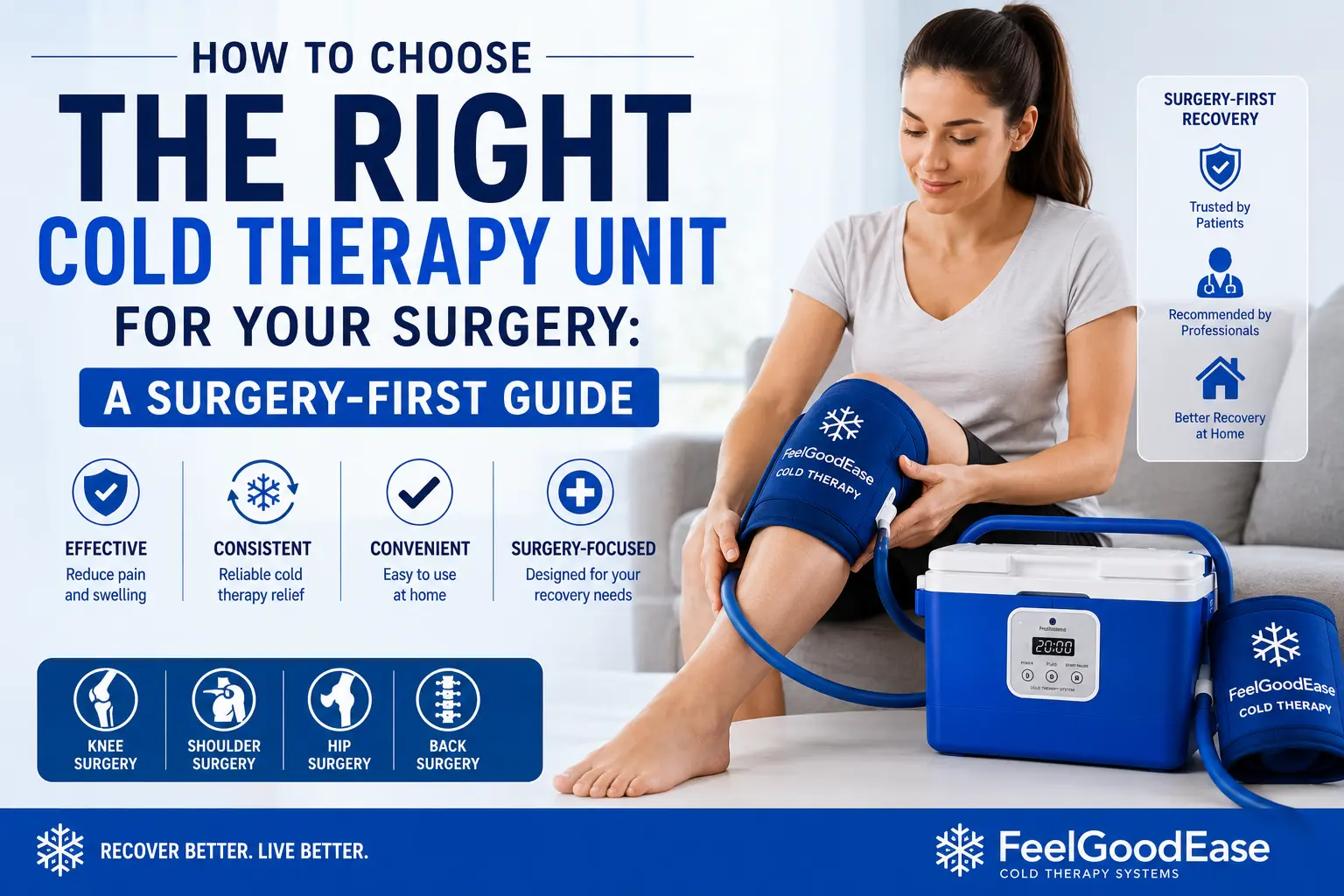

How to Choose the Right Cold Therapy Units for Your Surgery: A Surgery-First Guide
You’re already in pain. The last thing you need is a spreadsheet with seventeen cold therapy units, a dozen conflicting reviews and a nagging fear that you’ll drop $300 on a machine that doesn’t even fit your shoulder. Yet that’s exactly where most patients land after a quick search. The internet is loud with “top 10” lists, affiliate-driven rankings and well-meaning forum threads that leave you more confused than when you started.
The stakes are higher than a bad purchase. Choose the wrong unit and you might get a pad that won’t wrap your knee properly, a pump so loud it ruins your sleep or a system that delivers lukewarm water by day three. Inadequate cold therapy is one of the 10 recovery mistakes that can prolong your recovery. When you’re already managing post-surgical stress, a prolonged recovery is the last thing you need.
This guide cuts through the noise with a surgery-first framework. Instead of starting with brands or features, we start with you: your procedure, your recovery environment and what your body actually needs to heal.
We’ll walk you through the three types of cold therapy units: gravity-fed, motorized, and active compression and show you exactly which one aligns with your surgery. You’ll get a quick-reference comparison table, surgery-specific picks and an interactive quiz that narrows your options in under ten minutes. No affiliate agendas, no guesswork.
Key Takeaways
- The right cold therapy unit depends on your surgery type, major joint replacements benefit most from active compression, while minor procedures may only need a simple gravity-fed system.
- Motorized units with active compression (like Game Ready or Breg Wave) reduce swelling and pain more effectively than cold alone, but cost $300–$600+.
- Always confirm pad availability for your specific body part before buying, a backordered pad can leave you without therapy right after surgery.
- Many insurance plans don’t cover cold therapy units, especially active compression models, but you can use HSA or FSA funds. Refurbished units from authorized dealers can save you 40–60%.
- Follow your surgeon’s protocol: typically 20–30 minutes of use every 2–3 hours, always with a barrier between the pad and your skin.
Before we compare units, you need to understand what cold therapy actually does for your body. The science is simpler than you think, and it’ll make every recommendation in this guide click.
How Cold Therapy Works: The Science of Cryotherapy and Compression
You know cold therapy helps, but understanding modern cold therapy makes choosing the right unit much easier. The science isn’t complicated and once you see the mechanisms, you’ll know exactly what to look for in a machine.
The Physiology of Cold Therapy
When you apply cold to a surgical site, blood vessels constrict. This vasoconstriction reduces blood flow to the area, which limits the rush of inflammatory fluid that causes swelling and tissue damage. The effect is most powerful in the first 48 to 72 hours after surgery, when the body’s inflammatory response peaks.
Cold also numbs nerve endings, providing natural pain relief without medication. And by slowing cellular metabolism, it reduces the oxygen demand of injured tissues helping them survive the initial trauma.
Many patients continue using cold therapy well into early rehabilitation and it can also help with cold therapy for arthritis pain. Even after the acute phase, cooling the joint can calm flare-ups after physical therapy sessions and make movement more tolerable.
The Role of Compression
Cold alone is helpful, but understanding heat vs cold therapy can help you decide when to use each. Gentle, even pressure prevents fluid from pooling in the tissues, directly countering the swelling that stiffens joints and delays healing. Compression also improves circulation by helping veins return blood to the heart, which clears waste products and brings in nutrients.
And by stabilizing the area, it reduces pain during movement. You’re less likely to guard the joint, which lets you start range-of-motion exercises sooner.
The real leap comes from active intermittent compression. Unlike a static elastic wrap, a motorized unit cycles pressure on and off, mimicking the body’s natural muscle pump. This rhythmic squeeze-and-release pushes fluid out of the limb far more effectively than constant pressure. Research consistently shows that combining cold with active compression produces significantly better outcomes than cold alone: less pain, less swelling, and faster return of function.
Clinical Evidence Supporting Cold and Compression
The data backs up what physiology suggests. A 2024 randomized controlled trial by Quesnot and colleagues compared compressive cryotherapy to standard cold therapy after total knee arthroplasty. The group using cold plus active compression had significantly larger improvements in joint swelling, pain during activity, walking distance, and overall knee function. They also regained knee flexion range of motion faster.
Another 2023 RCT by Marinova et al. specifically tested a Game Ready device, a well-known active compression unit, after total knee replacement and found it effective. Broader reviews, including a 2023 meta-analysis in Frontiers in Surgery and a 2024 systematic review by WorksafeBC, confirm that continuous cold therapy, especially when paired with compression, improves recovery after joint surgery. While some older studies showed mixed results, the weight of evidence now clearly favors the combination.
These aren’t marginal gains. The Quesnot study reported a statistically significant reduction in pain during activity and a measurable boost in functional outcomes. For a patient, that translates to fewer painkillers, earlier mobility, and a smoother path back to daily life.
Expert Tip: For major joint surgeries, active compression units, which use a motor to cycle pressure, have been shown to reduce swelling and pain more effectively than passive wraps, potentially speeding up your recovery.
Now that you understand the science, let’s look at the three types of units that deliver it, and why the differences matter for your recovery.
Types of Cold Therapy Units: Gravity-Fed vs Motorized vs Active Compression
All cold therapy units circulate cold water through a pad, but how they move that water, and whether they add compression, changes everything about your experience. The market splits cleanly into three tiers, each with a distinct trade-off between cost, convenience, and clinical effectiveness. Understanding these tiers is what lets you stop comparing spec sheets and start matching a machine to your actual recovery.
Gravity-Fed Systems
The simplest design. You fill a reservoir with ice and water, hang it above the treatment area, and let gravity pull cold water through the pad. When the water warms up, you drain it back into the reservoir, add more ice, and repeat. No pump, no power cord, no noise.
The appeal is obvious: gravity-fed units are the most affordable way to get circulating cold therapy. They’re silent, portable, and work anywhere. For a minor arthroscopic procedure or a backup unit, that’s often enough.
The trade-offs are real. Temperature drifts as the ice melts, so cooling isn’t consistent. You’ll be draining and refilling the reservoir every 20 to 30 minutes, which gets old fast when you’re trying to rest.
And because there’s no active compression, swelling reduction relies entirely on cold alone: effective, but not the most powerful option. For larger joints like the knee or shoulder, a gravity-fed pad can struggle to maintain good contact and even cooling.
Product Recommendation: The Aircast Cryo Cuff is the most recognized gravity-fed option, lightweight and easy to use for typically under $100.
Motorized Cold Therapy Units
Add an electric pump and you get a motorized unit. The pump circulates cold water continuously from a cooler-style reservoir, maintaining a steady flow and a more consistent temperature. You fill the reservoir with ice and water once, and the machine handles the rest: no manual draining, no lifting a bag overhead.
This tier is the workhorse of post-surgical recovery. Consistent cooling means you can run longer sessions without babysitting the machine, and most motorized units come with a range of pad shapes for knees, shoulders, ankles, and backs. The pump does add a low hum and ties you to a power outlet, but for the majority of recoveries, that’s a minor inconvenience next to the convenience gain.
Product Recommendation: For motorized units, the Breg Polar Care Cube and DonJoy Iceman Clear3 are popular choices; the Ossur Cold Rush is a quieter alternative.
Active Compression Systems
Active compression is the premium tier. These systems combine motorized cold circulation with a pump that rhythmically inflates and deflates the pad: intermittent compression that mimics your body’s natural muscle pump. Instead of just cooling the tissue, they actively push swelling away from the joint.
The clinical difference is not subtle. A 2024 randomized controlled trial in knee replacement patients found that compressive cryotherapy produced significantly larger improvements in joint effusion, pain during activity, walking distance, and overall knee function compared to standard cold therapy alone.
Active compression is the only tier that adds intermittent compression: that compression is clinically proven to reduce swelling more effectively than cold alone. That matters most after major joint replacements, rotator cuff repair, or ACL reconstruction, where controlling swelling early can speed up range of motion and pain relief.
The trade-off is cost and complexity. Active compression units are the most expensive, bulkier and louder than the other tiers. Setup takes a few extra minutes, and you’ll need a power outlet. But for patients who want the fastest possible recovery and are willing to invest in it, the evidence points here.
Product Recommendation: Game Ready is the clinical gold standard for active compression, while Breg Polar Care Wave provides a more affordable mid-range alternative.
Expert Tip: Knee and shoulder recoveries benefit most from active compression units like Game Ready or Breg Wave, while minor procedures may only need a gravity-fed Aircast Cryo Cuff.
Once you know which type fits your surgery, the next step is comparing specific features: here’s your checklist.
Key Features to Evaluate When Choosing a Unit
You’ve identified your tier. Now look at the features that separate a great unit from a frustrating one. The right machine isn’t the one with the most bells and whistles. It’s the one that fits your surgery, your daily routine, and your tolerance for midnight ice runs.
Use this checklist to build a personal scorecard. Weight each feature by what matters most to you.
Temperature Control and Consistency
Steady cold keeps swelling in check, especially during the first 48 hours when inflammation peaks. A unit that cycles between icy and lukewarm forces your body to playcatch-up. Motorized pumps maintain temperature consistency far better than gravity-fed systems. Gravity-fed setups rely on you manually swapping water bottles.
Some premium motorized units let you set a target temperature and hold it for hours. Others simply circulate ice water without a thermostat, so the water gradually warms as the ice melts.
If you plan to run the machine overnight, active temperature regulation is worth the extra cost. This prevents the 3 a.m. wake-up call to add ice. The cold stays steady while you sleep.
Compression Type and Adjustability
Compression squeezes swelling away from the joint. Not all compression works the same way.
Passive compression comes from an elastic wrap or strap that applies static pressure. It is simple, quiet, and better than nothing. Static pressure does not adapt to your body’s changing needs.
Active compression uses a motorized pump to inflate and deflate the pad in cycles. This mimics the body’s natural muscle pump. Intermittent pressure moves fluid more effectively and can significantly reduce severe swelling.
Look for units that let you adjust both pressure levels and cycle times. Game Ready allows you to customize both. You can start with gentle compression right after surgery and increase intensity as you heal. A basic elastic wrap cannot offer that kind of control.
Pad Compatibility and Body Part Coverage
Verify pad compatibility before anything else. A unit is useless without the right pad for your exact surgery site.
Many brands use proprietary connectors. A Breg pad will not fit a DonJoy machine, and vice versa. Even within a brand, pads are surgery-specific. A knee pad will not work for a shoulder. A universal pad may not contour well enough to deliver effective cold.
Check the manufacturer’s website for a pad compatibility chart. Confirm the pad you need is in stock and sized correctly. A too-small pad misses the swelling. A too-large one will not stay in place. This step alone prevents the most common buying mistake I see.
Expert Tip: Before buying, verify the exact pad for your surgery site is in stock and compatible. A unit is useless without the right pad.
Reservoir Size and Therapy Duration
Reservoir size dictates how long the unit runs before you need to add ice. Gravity-fed systems typically last around 2 to 4 hours on a full cooler. Motorized units stretch that to roughly 6 to 8 hours.
If you want uninterrupted overnight therapy, a larger reservoir is non-negotiable. Smaller reservoirs mean more frequent refills. These disrupt rest and can lead to gaps in cold application.
Think about your daily rhythm. Will you be awake and able to swap ice every few hours? Or do you need a machine that runs from bedtime to morning without attention?
Expert Tip: For overnight therapy, choose a motorized unit with a large reservoir and adjustable temperature. It maintains steady cold without waking you for ice refills.
Noise Level and Home Use
Noise becomes a major factor when the machine sits next to your bed or couch for days. Gravity-fed systems are silent. No pump, no hum.
Motorized units vary widely. The Ossur Cold Rush is known for quiet operation. Some older motorized models produce a noticeable drone that can interfere with sleep or conversation.
Your recovery depends on rest. Do not underestimate how much a loud pump can wear on you.
Expert Tip: If you will use the unit while sleeping, check user reviews for noise complaints. Gravity-fed systems are silent, while motorized units like Ossur Cold Rush are notably quieter.
Portability and Ease of Use
You will be moving the unit from bed to couch to bathroom, often while on crutches. Weight, a sturdy carrying handle, and a simple filling process matter more than you would think.
Clear reservoirs, like the one on the DonJoy Iceman Clear3, let you see ice levels at a glance without opening the lid. Some units have one-button operation. Others use digital displays that can be confusing when you are groggy from pain meds.
Look for a wide opening for easy ice loading and a drain plug that does not require tilting the whole machine. The less friction there is in daily use, the more likely you are to stick with the therapy.
With your checklist in hand, here is how the top seven units stack up side by side.
Cold Therapy Unit Comparison Table
Here’s how all seven units compare across the features that matter most for post-surgical recovery.
Key Takeaways
- Gravity-fed units (Aircast Cryo Cuff, Breg Polar Care Cube) are the most affordable and quietest, ideal for knee and shoulder surgeries.
- Motorized units (DonJoy Iceman Clear3, Ossur Cold Rush, Polar Active Ice 3.0) offer longer, uninterrupted cold therapy without manual water changes.
- Active compression units (Breg Wave, Game Ready) provide the highest level of therapy but at a premium price; best for complex surgeries or accelerated recovery goals.
- Pad compatibility and fit vary widely. Always check that the unit supports a pad designed for your specific procedure.
| Unit Name | Type | Approx. Price Range | Therapy Duration Per Ice Fill | Compression Capability | Best For (Body Part/Surgery) | Noise Level | Key Strength | Pad Compatibility |
|---|---|---|---|---|---|---|---|---|
| Aircast Cryo Cuff | Gravity-fed | $100–$150 | 4–6 hours | Passive (elastic wrap) | Knee, shoulder, ankle | Quiet | Simplest setup; no electricity needed | Wide range of anatomical cuff sizes |
| Breg Polar Care Cube | Gravity-fed | $120–$180 | 4–6 hours | Passive (elastic wrap) | Knee, shoulder | Quiet | Large reservoir; easy to use | Universal pads fit most joints |
| DonJoy Iceman Clear3 | Motorized | $200–$280 | 6–8 hours | Passive (wrap) | Knee, shoulder, hip | Moderate | Continuous cold flow; clear reservoir | Procedure-specific pads available |
| Ossur Cold Rush | Motorized | $200–$300 | 6–8 hours | Passive (wrap) | Knee, shoulder, ankle | Moderate | Compact design; consistent temperature | Compatible with Ossur’s anatomical pads |
| Polar Active Ice 3.0 | Motorized | $220–$300 | 6–8 hours | Passive (wrap) | Knee, shoulder, back | Moderate | Digital timer; quieter than most motorized units | Universal pad with multiple straps |
| Breg Polar Care Wave | Active compression | $300–$400 | 6–8 hours | Active (intermittent) | Knee, shoulder, hip | Moderate | Combines cold and compression at mid-range price | Breg Wave-specific pads |
| Game Ready Cold Therapy System | Active compression | $400–$600+ | 6–8 hours | Active (programmable) | Knee, shoulder, ankle, spine | Moderate | Clinical-grade programmable compression | Extensive pad library for specific surgeries |
Expert Tip: If you’re torn between two units, prioritize the one with the best pad fit for your specific surgery. A poorly fitting pad undermines even the most advanced machine.
Numbers are helpful, but your surgery type is the single most important factor. Here’s what works best for each procedure.
Surgery-Specific Recommendations
Your surgery type is the single most important factor in choosing a unit. Here’s what works best for the most common procedures.
Knee Replacement and ACL Reconstruction
Knee surgeries demand aggressive swelling control. The joint is large, the surgical trauma is significant, and regaining range of motion quickly is critical. Clinical evidence consistently shows that active compression units outperform standard cold therapy for these procedures. They deliver faster reduction in swelling and measurably better knee flexion in the early weeks of recovery.
Product Recommendation: For total knee replacement, Game Ready’s active compression knee wrap is the clinical gold standard. The Breg Polar Care Cube with a knee pad is a reliable budget alternative.
Top pick: Game Ready or Breg Wave. Both provide motorized cold plus intermittent compression. Research links this combination to superior pain relief during activity and greater improvement in walking distance after surgery. The programmable pressure cycles actively pump swelling away from the joint, something a static wrap simply cannot do.
Budget alternative: Breg Polar Care Cube or DonJoy Iceman Clear3. These motorized units circulate cold water continuously without the compression feature. They still deliver consistent, hassle-free cooling and are a solid step up from gravity-fed systems for a demanding recovery.
Pad note: You need a knee-specific pad that wraps fully around the joint. Some manufacturers offer universal knee pads, while others make left- and right-specific versions. A contoured fit matters more than you might think. A poorly fitting pad leaves gaps over the most swollen areas.
Rotator Cuff and Shoulder Repair
Shoulder surgery presents a unique challenge: the joint is complex, and you’ll likely be in a sling or immobilizer for weeks. A pad that can’t fit comfortably over that bulky setup is useless. Motorized circulation also becomes important here. Gravity-fed systems require you to raise and lower the cooler, which is awkward when one arm is immobilized.
Top pick: Game Ready or Breg Wave with a dedicated shoulder pad. The active compression helps manage swelling in a joint where movement is severely restricted. The consistent cold penetration reaches deep into the rotator cuff and surrounding tissues.
Budget alternative: DonJoy Iceman Clear3 with a shoulder pad. The motorized pump keeps cold water moving without manual intervention. You can set it up and let it run while you rest.
Pad note: Shoulder pads often use vest-like designs that wrap around the torso and secure over the shoulder. Before you buy, check that the pad fits comfortably over your specific sling or immobilizer. Some are bulkier than others. A poor fit will make you less likely to use the unit consistently.
Ankle Arthroscopy and Foot Surgery
Ankle and foot procedures often don’t require the same firepower as a knee replacement. The joint is smaller, swelling tends to be more localized, and the recovery position (leg raised, minimal movement) makes simpler systems perfectly adequate.
Top pick: Aircast Cryo Cuff. This gravity-fed system is lightweight, silent and surprisingly effective for the ankle. You fill the cooler with ice and water, raise it and let gravity do the work. For many patients, it’s all they need.
Upgrade option: Ossur Cold Rush with an ankle pad. If you want motorized consistency without the cost of active compression, this unit delivers continuous cold. It’s easy to operate one-handed.
Pad note: Ankle pads are typically smaller and less expensive than knee or shoulder pads. Some brands offer foot-and-ankle combo pads that cover the entire area. These are helpful after procedures like bunion surgery or Achilles repair.
Spinal and Back Procedures
Back surgery involves significant muscle disruption, and the surgical site runs along the spine, not around a limb. That changes the pad requirement entirely. You need a large, flexible pad that can be positioned along the length of your back while you lie down or recline.
Top pick: Game Ready with a back pad, if available. The active compression can help control deep muscle swelling and may reduce post-operative muscle spasm. However, back pads are not as widely stocked as knee or shoulder pads, so availability varies.
Alternative: A motorized unit like the Breg Polar Care Cube or DonJoy Iceman Clear3 with a large flexible back pad. These units provide steady cold without compression. The pad can be positioned along the spine and held in place by your body weight.
Pad note: Confirm back pad availability before you purchase the unit. Not all retailers carry them. You don’t want to be stuck with a machine and no way to use it on your surgical site. Call ahead or check the manufacturer’s website directly.
Expert Tip: Surgeons often have strong preferences for specific cold therapy units based on clinical experience. Confirm their recommendation before purchasing.
Still weighing options? This five-step decision process will take you from overwhelmed to confident in under ten minutes.
If you’re still unsure, follow this simple five-step process. It’ll take you from overwhelmed to confident in under ten minutes.
Step-by-Step Decision Guide: How to Choose Your Unit
Step 1: Identify Your Surgery Type and Recovery Needs
Grab a notepad and write down your exact procedure. Not just “knee surgery” but “right total knee replacement” or “rotator cuff repair with biceps tenodesis.” This precision matters because a hip scope and an ACL reconstruction demand very different pad shapes and cooling coverage.
Now answer three questions.
First, how much swelling does your surgeon expect? Major joint replacements and ligament reconstructions typically produce significant, sustained swelling. Minor scopes or soft-tissue repairs may peak quickly and then taper.
Second, how mobile will you be? If you’ll be mostly in a recliner or bed for the first week, a gravity-fed system that needs to be raised above you might be a hassle. A motorized unit that sits on the floor and pumps continuously is far more convenient.
Third, did your surgeon specifically recommend compression? Some protocols explicitly call for active compression to reduce hemarthrosis and pain. If yours does, that narrows your options immediately.
Step 2: Set Your Budget
Cold therapy units fall into four clear price bands.
Under $100 typically gets you a gravity-fed system only. These are simple, reliable, and require no electricity, but you’ll need to manage the water level and elevation.
Between $150 and $250, you’re in motorized territory. A pump circulates cold water continuously, so you get consistent cooling without babysitting the setup.
From $300 to $400, you can typically access mid-range active compression units that inflate and deflate the pad on a cycle. Above $400 sits the premium active compression tier, typically with more refined pressure settings and often quieter pumps.
One budget trap catches nearly every first-time buyer: the pad is frequently sold separately. A motorized unit priced around $200 might look perfect until you realize the shoulder pad adds another $100 or more. Factor in typically $50 to $150 for the pad when you set your number. That way, you won’t be surprised at checkout.
Expert Tip: Refurbished Game Ready or Breg units from certified medical suppliers often cost 40–60% less than new and may include a warranty, as of publication.
Step 3: Determine Your Compression Needs
Here’s the decision logic that cuts through the noise. If you’re having a major joint surgery and your surgeon emphasizes swelling control, active compression is worth the investment. The intermittent squeeze helps move fluid out of the joint space more effectively than static cold alone. For a total knee or a rotator cuff repair, that can translate to less pain and a faster return to range of motion.
If your procedure is less invasive or your budget is tight, a motorized unit without compression still outperforms passive ice packs by a wide margin. The continuous circulation keeps the pad at a steady therapeutic temperature, something a bag of frozen peas can’t do. Reserve gravity-fed systems for small joints like an ankle or for temporary use when you only need cooling for a few days.
Step 4: Check Pad Availability and Compatibility
This step prevents the most expensive mistake you can make.
Before you click “buy” on any unit, verify three things.
First, is the specific pad for your surgery in stock and ready to ship? Backorders are common, especially for less popular joints.
Second, does the pad connector match your unit? Breg and Game Ready use proprietary connections. A Polar Care pad won’t fit a Game Ready unit, and vice versa.
Third, check the sizing. If you’ll be in a post-op brace, the pad must fit under or around it without bunching or restricting the brace’s straps.
Expert Tip: Confirm pad stock before purchasing the unit; backordered pads can delay your recovery by weeks.
Never buy the unit until you’ve confirmed the pad is in stock and fits your brace. That one rule saves more grief than any brand comparison ever will.
Step 5: Compare Your Top Options and Make a Decision
By now you’ve narrowed the field to two or three units that match your surgery, budget, and compression needs. Head to the comparison table in the next section to see them side by side.
Then do something most buyers skip: read reviews from people who had the same surgery you’re having. Knee replacement support groups are full of real-world feedback on noise levels, pad durability, and how well a unit held up through weeks of daily use.
Spec sheets won’t tell you that a particular pump is loud enough to wake you at 3 a.m., but a fellow patient will.
Check shipping times. Some units ship same-day, others take a week. If your surgery is in three days, that difference matters. Still torn? Use the interactive quiz at the end of this guide. It’ll match you to a unit based on your answers.
You’ve picked your unit. Now let’s talk about what you’ll actually pay, whether insurance helps, and where to buy.
Cost, Insurance and Where to Buy
You’ve picked your unit. Now let’s talk about what you’ll actually pay, whether insurance helps, and how to get it in time for surgery. The sticker price is only part of the story. Pads, shipping, and a little pre-surgery legwork can shift the real cost by hundreds of dollars.
Price Ranges by Unit Type
Cold therapy units fall into clear price bands and the type of pump is the biggest driver.
- Gravity-fed systems typically run $50 to $100. They’re simple, no electricity needed, and the pad is usually included.
- Basic motorized units (continuous flow, no recirculation) typically land between $150 and $250. You’ll often need to buy the pad separately, which adds $30 to $60.
- Motorized units with recirculation typically sit at $200 to $300. The pump reuses chilled water, so you’re not constantly refilling.
- Mid-range active compression typically starts at $300 and goes to $400. These add intermittent pressure, and a universal pad is typically bundled.
- Premium active compression typically pushes past $400, often reaching $600 or more. Game Ready and Breg Wave sit here, and the pad is a significant part of the cost. Replacement wraps typically run $80 to $150 on their own.
Prices shift by retailer and whether a pad is included. Always check the listing for “pad included” before comparing.
Insurance Coverage and HSA/FSA Eligibility
Most private insurance plans do not cover a cold therapy unit for home use. They’re classified as durable medical equipment (DME), which means prior authorization is required and denials are common.
Aetna’s CPB 0297 policy, effective February 2026, states that passive cold compression devices may be covered as DME, but active mechanical cold units are generally not covered. Medicare and Medicaid rarely pay for them.
Expert Tip: Call your insurer and ask specifically about DME coverage for a ‘cold therapy unit’. If denied, confirm HSA/FSA eligibility and request a letter of medical necessity from your surgeon.
That letter is your key. With it, you can use HSA or FSA funds to pay for the unit, the pad and even shipping. Keep the receipt and the letter together. Breg Polar Care products, for example, are often classified as DME by many policies, which can make them eligible for coverage with proper documentation, but don’t count on a check. The HSA/FSA route is the reliable path.
Refurbished and Open-Box Options
A refurbished unit can often cut the price by 40 to 60 percent, putting a premium active compression system within reach. Game Ready and Breg units are frequently available refurbished from authorized dealers. These aren’t random eBay finds. You’ll find them inspected, cleaned, and often backed by a 90-day warranty and return policy.
Expert Tip: When buying used, verify the unit includes the pump, reservoir, hose, and power cord, and always purchase a new pad for hygiene.
Knee replacement support groups are another source. Real users regularly compare Breg Wave and Game Ready and sell gently used units at significant discounts. A quick search in those forums can surface a deal, but stick to sellers who can confirm the unit works and include all parts. A new pad is non-negotiable.
Shipping Timelines and Pre-Surgery Planning
Order at least two weeks before your surgery date. That gives you time to unbox the unit, run it for a test cycle and make sure the pad fits and seals correctly. If the pad is the wrong size or a hose leaks, you want that discovered on a Tuesday afternoon, not the night before surgery.
Expert Tip: If surgery is within a week, prioritize retailers with same-day or next-day shipping to avoid starting recovery without your unit.
Amazon, DME suppliers, and manufacturer-direct sites often offer expedited options. Local medical equipment stores are worth a call, too. Some keep motorized and gravity-fed units in stock for immediate pickup. For last-minute situations, that drive across town can be the difference between starting cold therapy on day one and waiting three days for a box.
Before you use your unit, there are safety rules you need to know. Cold therapy is safe when used correctly, but improper use can cause real harm.
Safety Guidelines and Usage Best Practices
Cold therapy is safe when used correctly and ice therapy for sore muscles is a common use but improper use can cause skin damage or even cold injury. Follow these guidelines. Always defer to your surgeon’s specific instructions.
Recommended Session Length and Frequency
The standard protocol is 20 to 30 minutes on, followed by at least 2 to 3 hours off. This gives your skin time to return to normal temperature and prevents the kind of prolonged cold exposure that leads to tissue damage.
Some surgeons permit continuous use for the first 24 to 48 hours after surgery, but only with a temperature-controlled motorized unit that maintains a safe, consistent temperature. Never attempt continuous cooling with a simple gravity-fed system. Those lack the safeguards to prevent dangerous temperature drops.
Expert Tip: Always follow your surgeon’s protocol for session length and frequency. Most recommend 20-30 minutes on, 2-3 hours off. Overuse can cause skin damage even with temperature-controlled units.
Pain medications can mask the discomfort that normally signals it’s time to stop. Many patients find that setting a timer removes the guesswork. If you’re drowsy or distracted, a timer is your best defense against accidental overuse.
Skin Protection and Preventing Cold Injury
A barrier between the pad and your skin is non-negotiable. Never apply the pad directly to bare skin. Even a thin cloth, a pillowcase, or the pad’s built-in fabric cover is enough to prevent frostbite and nerve damage. The cold still transfers effectively through a single layer, so you aren’t sacrificing pain relief by protecting yourself.
Check your skin every 20 minutes. Look for excessive redness, numbness, blistering, or a waxy appearance. If you notice any of these, stop using the unit immediately and let the area warm up.
Certain conditions make cold therapy riskier. If you have circulatory problems, Raynaud’s disease, or nerve damage, get explicit clearance from your doctor before using any cold therapy unit.
Contraindications and When to Avoid Cold Therapy
Cold therapy has some important contraindications and isn’t for everyone. Absolute contraindications include cold hypersensitivity, cryoglobulinemia and paroxysmal cold hemoglobinuria. These are rare but serious conditions where cold exposure can trigger a systemic reaction.
If you have any chronic health issues, disclose your full history to your surgeon. Don’t assume cold therapy is automatically safe.
Never apply a cold therapy pad to open wounds or unclosed incisions without your surgeon’s direct approval. The moisture and pressure can interfere with healing.
And if you experience increased pain, swelling or any skin changes during use, discontinue immediately and contact your care team. A cold therapy unit should reduce discomfort not create new problems.
You probably still have questions. Here are the answers to the ones we hear most often.
How do I clean and maintain the unit?
Between uses, wipe down the pad with a mild soap and water solution and let it air dry completely. Empty the reservoir and refill it with fresh ice and water each day to prevent bacterial growth. Most units need nothing more than that. Check the manufacturer’s instructions for proper cleaning and use of your unit, but the routine is simple enough to become second nature.
Still not sure which unit is right for you? Our interactive quiz will give you a personalized recommendation in under two minutes.
Interactive Decision Quiz: Find Your Match
Still not sure? This interactive quiz will give you a personalized recommendation in under two minutes.
How the Quiz Works
You answer four to five straightforward questions about your surgery, budget, and preferences. The quiz then matches you to one of the seven cold therapy units from our comparison table, with a brief explanation of why it’s the best fit for your recovery.
The questions mirror the decision factors we’ve covered surgery type, budget range, whether you need active compression, the body area you’ll be treating and your tolerance for pump noise. The quiz uses a surgery-first matching logic that narrows seven units to one best fit: no guesswork. No medical jargon. No sales pitch. Just a clear, personalized result.
Sample Questions and Logic
Here’s how the logic branches in practice:
- If you’re recovering from a knee replacement, have a budget over $300, and want active compression, the quiz points you to the Game Ready or Breg Wave. Both deliver motorized cold and intermittent compression, which research shows can reduce swelling faster after major joint surgery.
- For an ankle procedure with a budget under $150 and no compression need, the recommendation is the Aircast Cryo Cuff. It’s a gravity-fed system that’s simple, quiet, and effective for smaller joints.
- If you’re unsure about compression, the quiz asks a follow-up about your swelling expectations. Heavy, persistent swelling? Active compression helps. Mild swelling you can manage with elevation? A motorized or gravity-fed unit will do the job.
Every result includes a clear, concise explanation that links back to the relevant comparison table and section of this guide, so you can verify the logic yourself.
Embedding the Quiz
Place the quiz right after the Step-by-Step Decision Guide section. Add a call-to-action like: “Still not sure? Take our 2-minute quiz to get a personalized recommendation.” Build it using a JavaScript-based tool or a WordPress plugin such as WP Quiz. Keep the logic transparent and ensure every recommendation aligns with the guide’s content. The results page should link back to the relevant article sections for deeper reading.
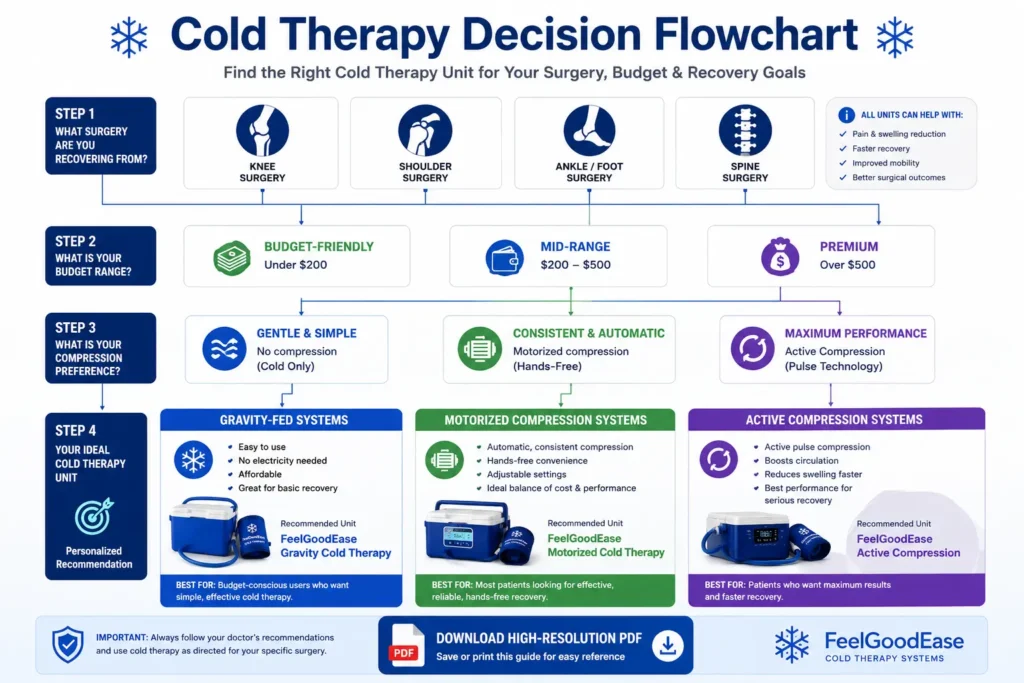
Prefer to see the decision process visually? Here’s a flowchart you can follow step by step, and even download.
Visual Decision Flowchart
If you’re a visual thinker, this flowchart maps the entire decision process: follow the branches to your recommendation.
Flowchart Design
The decision flowchart starts with a single question: “What surgery are you having?” From there, it branches by surgery type, then budget then compression preference, leading you to one of the seven units covered in this guide. Each path uses clear icons and color-coding blue for gravity-fed, green for motorized, and purple for active compression, so you can scan the chart in seconds.
Key Decision Points
The flowchart turns the guide’s surgery-first logic into three simple branch points.
- Surgery type. Major joint procedures (knee replacement, rotator cuff repair) demand continuous cold and often active compression. Minor surgeries (ankle arthroscopy, small scopes) can often manage with a gravity-fed system.
- Budget. The chart splits into three tiers: under $150, $150–$300, and $300+. Each tier narrows the options to units that deliver real value at that price.
- Compression. The final fork asks: do you need active compression? If yes, the chart routes you to the premium tier. If no, it recommends a motorized unit. If you’re not sure, the default path is a motorized unit without compression: the safest, most budget-conscious choice for most recoveries.
Methodology and Objectivity
You deserve to know how we arrived at these recommendations. Most cold therapy guides start with a brand and work backward, but that’s not how recovery works. We built this guide around a surgery-first framework, matching the right type of unit to your specific procedure, not to a manufacturer’s marketing budget.
While this guide covers many of the most recognized cold therapy systems used in orthopedic recovery, they are not the only options available. Newer recovery-focused brands have also introduced reliable cold therapy solutions designed for home use. When evaluating any brand including established names and newer alternatives such as FeelGoodEase focus on practical factors like consistent cooling performance, comfortable anatomical wraps, replacement part availability, ease of setup, warranty support and how well the system matches your specific surgery rather than relying on brand recognition alone.
Our Evaluation Criteria
We assessed every unit against five criteria that matter most during recovery.
Clinical effectiveness comes first: does the unit deliver consistent cold and, where applicable, reliable compression to reduce swelling? User experience covers the daily reality: ease of setup, noise level, portability, and pad comfort, drawn from aggregated patient reviews and hands-on testing.
Value weighs price against features and durability, including the availability of refurbished options that can make a motorized unit affordable. Availability means you can purchase the unit easily from reputable DME suppliers, not just a single sketchy listing. Finally, brand reputation in orthopedic rehabilitation reflects the trust physical therapists and surgeons place in the manufacturer over years of clinical use.
How We Selected and Ranked Units
We started with over 15 units mentioned on patient forums, in physical therapist recommendations, and across major DME supplier catalogs. From that list, we narrowed to a handful that represent the full spectrum of types and price points, gravity-fed, motorized, and active compression, across the brands you’ll actually encounter: Breg, DonJoy, Game Ready, Aircast, and Ossur.
Rankings are not a single numeric score. Each unit is positioned based on its suitability for a specific use case, because the “best” machine for a knee replacement isn’t the same as the best for a rotator cuff repair.
Limitations and Disclosures
We don’t sell any of these units and have no financial relationships with manufacturers. This guide is editorially independent. Prices and availability change, so we update the guide annually. Individual results vary, so always consult your healthcare provider before purchasing. Recovery is personal, and no guide can replace a clinician who knows your full history.
Frequently Asked Questions
What is the difference between gravity-fed, motorized, and active compression cold therapy units?
Gravity-fed units use a raised reservoir and no pump; they are silent and affordable but require manual refills and offer inconsistent cooling. Motorized units use a pump for continuous cold circulation and more consistent temperature. Active compression units add intermittent pneumatic compression to actively reduce swelling, providing the most effective therapy for major joint surgeries.
Does insurance cover cold therapy units?
Most private insurance plans do not cover cold therapy units for home use, especially active compression models. They may be classified as durable medical equipment (DME) requiring prior authorization, and denials are common. However, you can often use HSA or FSA funds with a letter of medical necessity from your surgeon.
How long should I use a cold therapy unit after surgery?
The standard protocol is 20 to 30 minutes on, followed by at least 2 to 3 hours off. Some surgeons may permit continuous use for the first 24 to 48 hours with a temperature-controlled motorized unit, but always follow your surgeon’s specific instructions to avoid skin damage.
Can I use a cold therapy unit while sleeping?
Yes, but only with a motorized unit that has a large reservoir and adjustable temperature to maintain safe, consistent cooling overnight. Gravity-fed systems are not suitable for continuous use while sleeping because they lack temperature regulation and can cause dangerous temperature drops.
Which cold therapy unit is best for knee replacement?
Active compression units like Game Ready or Breg Wave are the clinical gold standard for total knee replacement because they combine cold with intermittent compression to reduce swelling and improve knee flexion faster. Budget-friendly motorized alternatives include the Breg Polar Care Cube or DonJoy Iceman Clear3.
How do I clean and maintain a cold therapy unit?
Wipe down the pad with mild soap and water after each use and let it air dry. Empty the reservoir daily and refill with fresh ice and water to prevent bacterial growth. Follow the manufacturer’s instructions for any additional cleaning steps.
